
Renault's E-Space Concept Reimagines the Minivan for the Electric Era
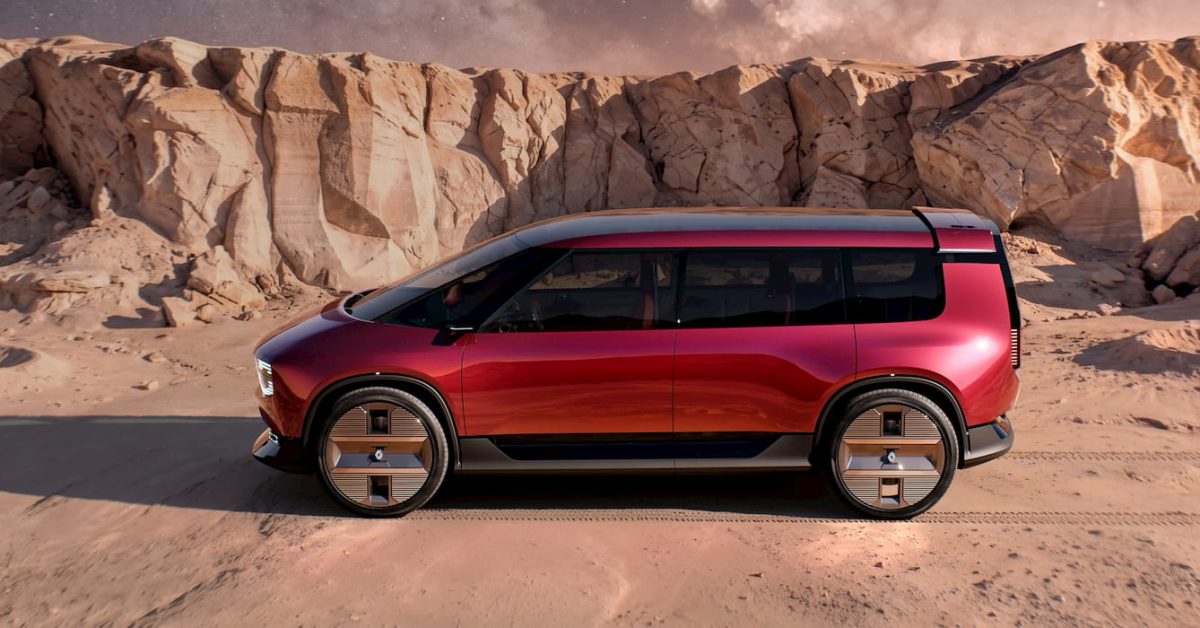
Renault is betting that the humble people carrier deserves a second act. At the Paris Motor Show, the French automaker pulled the wraps off the E-Space Concept, a fully electric MPV that it positions as a spiritual heir to the original Espace that debuted back in 1984.
The pitch is straightforward: families who need space shouldn’t be forced into tall, heavy SUVs. Measuring 4,700 mm long, 2,020 mm wide and 1,670 mm tall, the E-Space lands in roughly the same footprint as Kia’s PV5 Passenger and the short-wheelbase version of Volkswagen’s ID. Buzz. By sitting lower than a conventional SUV and adopting smooth surfacing plus a roof spoiler that nods to the second- and third-generation Espace, Renault argues the concept can deliver space without the aerodynamic penalty.
Inside is where the concept earns its keep. Renault’s designers drew on Bauhaus principles — specifically the glass-forward thinking of architect Ludwig Mies van der Rohe — to create a cabin with an unusually low waistline and glazing that extends far beyond it. The result is a space you can see into while standing beside the vehicle. The double-hinged rear doors swing open onto six individual seats arranged on a flat floor, each mounted on lacquered, floating shells rather than conventional buckets. Second-row seats swivel a full 180 degrees to face the third row, and passengers get folding tray tables plus 12.3-inch screens built into the headrests. Fold the second row away and a four-seat layout emerges, complete with a remote-controlled center console housing an air purifier, a small fridge, video game controllers and a Connect 4 set. Ambient lighting runs the length of the cabin, night lights are tucked into the speakers, and reading lamps hang from a rail running down the middle of the glass roof.
Up front, a pillar-to-pillar curved display called OpenR Panorama is joined by a central infotainment touchscreen, both able to pivot around a base behind the steering wheel. That wheel is compact and uses steer-by-wire technology, which Renault says frees the design from the physical constraints that normally dictate steering geometry. The brand has stopped short of confirming a production date or even a commitment to build the E-Space, describing it instead as a contemporary take on family travel in the electric age and a signal of where its design thinking is headed.
For Renault, the concept also serves a strategic purpose. The minivan segment has been squeezed for years as buyers migrated toward crossovers, but the packaging advantages of a dedicated EV platform — flat floors, short overhangs, flexible seating — play directly to MPV strengths. If the E-Space ever reaches showrooms, it would compete in a small but growing field of electric people movers alongside the ID. Buzz and Kia’s PV5, a niche that has yet to prove it can pull buyers back from SUVs at scale.
What do you think?