
Rare Spanish-Built 1975 Land Rover Santana 1300 Hits the Market
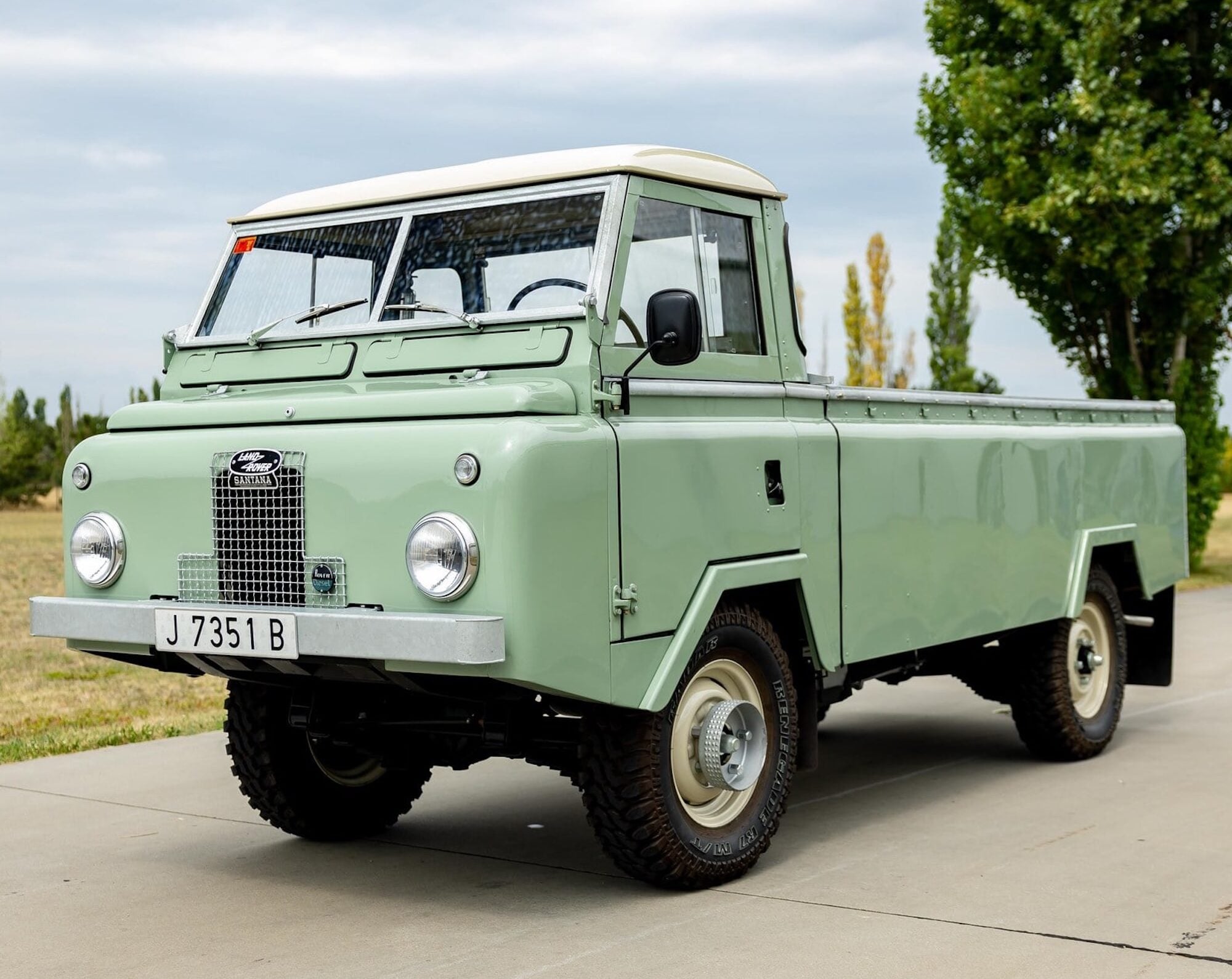
Most people who spot a forward-control Land Rover assume they are looking at a British Series IIA Forward Control. This one is different. The truck you see here is a Land Rover Santana 1300, a machine designed and assembled in Spain on a long-wheelbase Santana chassis, and it is now up for sale following a restoration that is said to have consumed more than 1,000 hours of labor.
The story behind the 1300 begins with Metalúrgica de Santa Ana, the Linares-based firm that started out building agricultural machinery before striking a licensing deal with Rover in 1958. That agreement carried a strict local-content clause: Spanish-made parts had to account for 75 percent of the first 1,500 vehicles, 85 percent of the next 1,000, and 95 percent thereafter. Meeting those targets required real ingenuity, right down to swapping imported spark plugs for Spanish ones. Early customers were overwhelmingly public-sector fleets, including the army, the Guardia Civil, the Policía Armada, the public works ministry, and the national telephone company.
Santana’s engineers wanted a truck that preserved Land Rover off-road capability while hauling far more cargo than the standard models. Their answer, introduced in 1967, moved the cab forward over the engine, freeing up a long load bed behind it. The name came straight from the payload rating: 1,300 kilograms, or 2,866 pounds. Underneath sat a steel ladder frame, live axles front and rear on semi-elliptic leaf springs, a four-speed manual gearbox, and a dual-range transfer case offering either rear- or four-wheel drive. Power typically came from a 2.25-liter four in petrol (around 80 bhp) or diesel (a little over 60 bhp) form, with some examples fitted with Santana’s own six-cylinder unit. At roughly 4.84 meters long and weighing between 1,760 and 1,840 kilograms, performance was modest at best, but buyers valued the 1300 for slow-speed load carrying, toughness, and the wide range of body configurations on offer. Most left the factory as chassis-cabs, though Santana also sold van and canvas-topped pickup versions.
Production ran through 1978, with total output usually estimated at around 4,000 units, and only a small fraction of those are believed to survive. Spain’s military, police, fire services, and public works agencies relied on the 1300 heavily, particularly for wildfire response, where the trucks hauled water, crews, and equipment over difficult terrain. Its successor, the Santana 2000, arrived in 1979 and went on sale in 1981, keeping the forward-control layout and adopting Santana six-cylinder engines as standard.
The 1975 example listed here is reported to have been restored comprehensively, covering the chassis, wiring loom, bodywork, interior, paint, and the timber floor in the rear load area, with original parts retained and a photographic record included in the paperwork. It runs a 2.3-liter diesel paired with a four-speed manual and part-time four-wheel drive, is configured with nine seats, and has disc brakes. The odometer shows approximately 11,256 kilometers, and its technical inspection is valid until January 2027. For collectors chasing a genuinely uncommon vintage 4x4 rather than the usual British-built suspects, this Spanish oddity is worth a closer look.
What do you think?