
Rare Blind Back: 1931 Ford Model A 160-C De Luxe Fordor Listed at $25,000
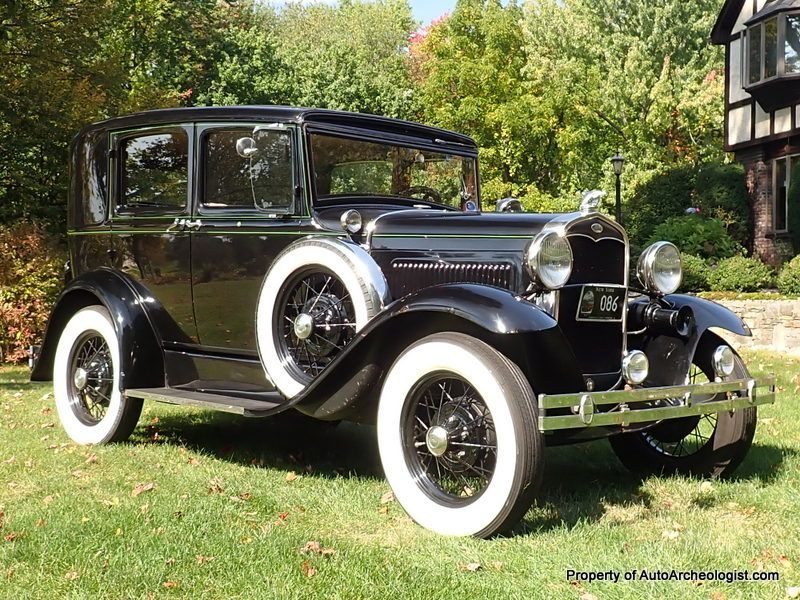
Most Model A Fords that turn up for sale are Tudors or standard Fordors, so a 160-C De Luxe Fordor stands out immediately — largely because of what it doesn’t have. The rear quarter windows are missing, replaced by solid body panels that gave back-seat riders far more privacy than the typical example of Ford’s ubiquitous four-cylinder car. The Model A Ford Club of America catalogues the 160-C as a 1931 De Luxe Fordor Sedan with a slant windshield and these so-called blind rear quarters. Because factory records lumped the body style together with the earlier 170-B, production totals for this late variant shift depending on who is counting, but nobody disputes that it is considerably scarcer than a Tudor or a conventional Fordor. A pull-down shade over the rear glass reinforces the enclosed, private-car character, while four doors and a roomy back seat keep it among the more usable Model A configurations.
This particular example is offered from Ellington, Connecticut with an asking price of $25,000 and a clean title. Its documented history is said to reach back roughly four decades, passing through North Carolina and Washington State before returning to the East Coast in 2019. Along the way it spent time with a board member of the Model A Restorers Club. The previous owner reportedly cared more about driving his cars than displaying them, so the work that went into the car was aimed at dependability rather than trophies. Under the hood sits a replacement 201-cubic-inch L-head inline-four said to have covered around 10,000 miles, mated to a rebuilt three-speed manual. A Mitchell Gear-Splitter overdrive has been added to make longer journeys less stressful on the drivetrain, and the electrical system has been converted to 12 volts with an alternator.
That electrical upgrade brings a long list of practical modern touches: LED brake lights, turn signals, and charging outlets. The cowl lamps now double as front indicators, and the seller states that the headlights, twin taillights, auxiliary brake light, fog lamps, horn, instruments, and wipers are all functional. Cosmetically the car carries plenty of period presence — black paint with green accents, twin side-mounted spare tires, whitewall tires, a rear trunk, wind wings, a spotlight, and a traffic-light viewer. The beige interior has been replaced at some point and still shows well in the photos provided. It is not being advertised as a concours-level restoration, though. The paint carries chips and other age-related imperfections, including a scrape along the roofline on the passenger side, and one of the slightly oversized 5.50-19 Lester tires has developed a bubble that ought to be sorted before any serious touring. An Autolite heater is included with the car but is not currently fitted.
The odometer reads roughly 35,000 miles across five digits, though the true total chassis mileage is unknown. What matters more for a buyer is that this Model A was set up for regular road use rather than short hops around a show field; the overdrive and the electrical work should make it a far more pleasant traveling companion, and its unusual body style will still draw attention wherever it lands. For someone weighing the purchase, the question comes down to philosophy: leave the well-worn finish alone and keep piling on the miles, or spend the money on paintwork and push the car closer to show condition?
What do you think?