
Rare 1959 BMW 503 Barn Find Emerges After 35 Years in Storage
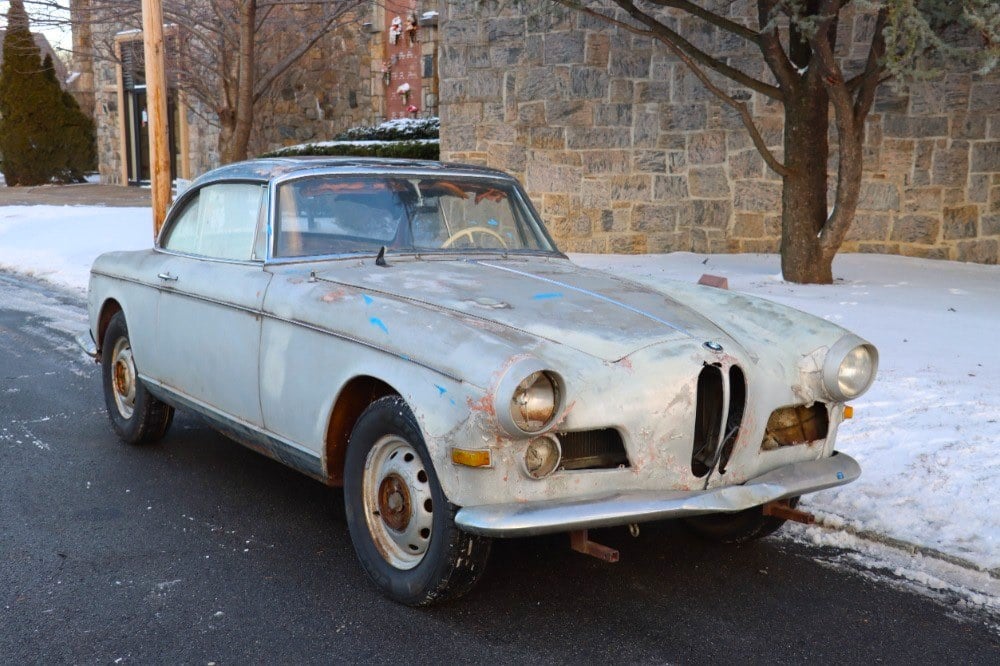
A silver BMW 503 coupe that has sat untouched for 35 years has surfaced for sale out of Astoria, New York, giving collectors a shot at one of the scarcest hand-built grand tourers to wear the Bavarian roundel. The car is presented as an original, unrestored, matching-numbers example that was imported to the United States in the early 1970s before being tucked away for long-term storage. Finished in silver over a tan interior, it is described as complete and largely intact, though it does not currently run and will require a full restoration.
The 503 began life in 1956 as BMW’s answer to the grand touring establishment, aimed squarely at Mercedes-Benz, Jaguar, Maserati and Aston Martin. Albrecht von Goertz, the designer also responsible for the celebrated 507 roadster, penned the body, while the mechanical package borrowed heavily from BMW’s 501 and 502 luxury sedans. That meant a steel box-section chassis with independent front suspension and a live rear axle, wrapped in aluminum bodywork. Under the hood sat BMW’s 3.2-litre aluminum V8, a 90-degree pushrod unit with wet cylinder liners and a five-bearing crankshaft, breathing through twin Zenith downdraft carburetors. Output was quoted at 138 bhp and 159 lb ft, enough for a 118 mph top speed despite a curb weight of roughly 1,500 kg.
The model evolved into a Series 2 in late 1957, a revision that moved the four-speed gearbox forward to bolt directly to the engine and swapped the column shifter for a floor-mounted lever. Electric window lifts replaced the earlier electro-hydraulic setup, and the chrome trim along each flank was straightened to run cleanly to the tail. Those changes mattered to buyers, but not enough to save the car commercially. Just 412 examples were built before production ceased in 1960, split between 273 coupes and 139 cabriolets, with 219 of the total falling into Series 1 specification and 193 into Series 2.
The 503’s commercial failure had roots in a decision made well before the first customer car was delivered. Max Hoffman, BMW’s New York importer, had pushed for a sports car priced near $5,000 and promised significant orders if the company could hit that figure. He also steered BMW toward Goertz, who took the assignment for the 507 roadster and soon added the 503 to his brief. But when both cars appeared at the 1955 Frankfurt Motor Show, their prices came in at more than double Hoffman’s recommendation, and he walked away from the arrangement on the spot, leaving BMW without a US dealer network. Some observers have suggested the company priced high to take on Mercedes-Benz directly, but whatever the reasoning, it proved among the costliest misjudgments of BMW’s post-war era.
For collectors, this car’s appeal rests on its condition and rarity. The combination of long-term storage, an untouched interior and a matching-numbers drivetrain makes it a strong restoration candidate, particularly given how few 503 coupes were ever assembled. Designer Albrecht von Goertz recalled in 1978 that Battista “Pinin” Farina had called the 503 the most beautiful car he had ever seen, a remark that has aged well. Buyers should note one discrepancy in the listing: the headline identifies the car as a 1959 model, while the description states 1957. With BMW’s attention already turning toward the more modern Bertone-bodied 3200 CS that replaced the 503 in 1962, survivors like this one represent the end of an unusually ambitious chapter in the marque’s history.
What do you think?