
Porsche Cayenne S Coupé Electric Tested: 390 kW Charging and a 113 kWh Pack
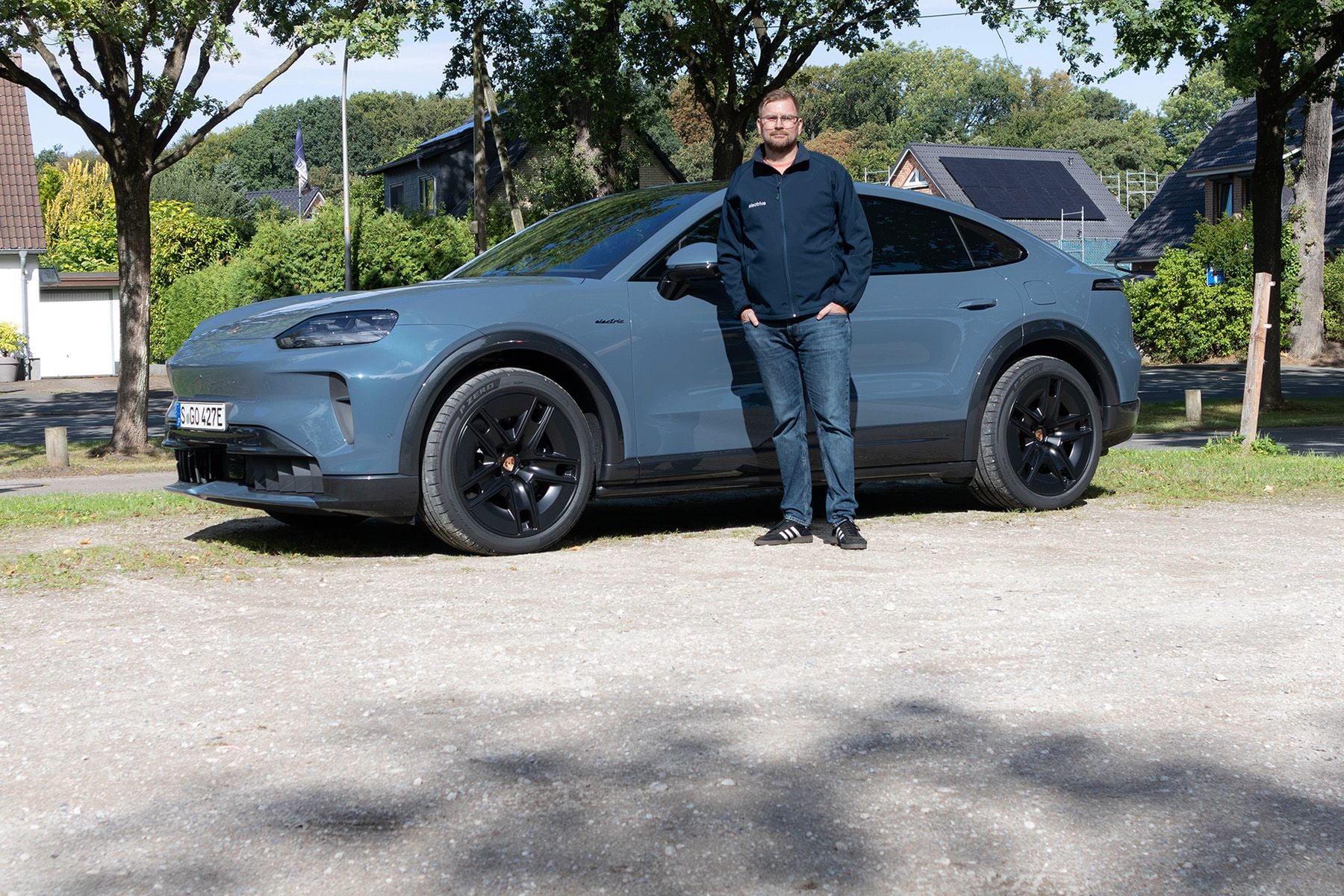
Porsche’s decision to build a fully electric version of its biggest SUV has now moved from premiere to showroom reality. The Cayenne Electric debuted in November 2025, production started in Bratislava in early February 2026, and the S Coupé variant arrived in March, slotting between the base model and the Turbo. It is a lineup built around three very different power outputs — and the S sits right in the middle of that ladder.
Where the base Cayenne makes 300 kW (325 kW with Launch Control) and the Turbo jumps to 630 kW (850 kW with Launch Control), the S delivers up to 400 kW in normal use and 490 kW when Launch Control is engaged. That is enough for a 3.8-second run to 100 km/h and a 250 km/h top speed. The base car is quoted at 4.8 seconds and 230 km/h, the Turbo at 2.5 seconds and 260 km/h. In practice, the mid-range model’s instantly available torque makes overtaking feel effortless, and repeated full-throttle bursts did not trigger an early power cut.
Underneath, the Cayenne shares the Premium Platform Electric with the Macan, but two core components were re-engineered rather than carried over. The battery sits more deeply integrated into the vehicle structure, and the S gets an oil-direct-cooled rear motor, a unit reserved for S and Turbo. Rather than drawing heat through an outer water jacket, a non-conductive oil pulls it straight from the copper windings, which Porsche credits with sustained performance under load and up to 98 per cent motor efficiency. The same cooling advantage is offered as one reason the S travels slightly farther than the base model despite its extra power. A 113 kWh gross pack (about 108 kWh usable) uses six modules and 192 pouch cells, switching from the Macan’s prismatic format to a nickel-rich NMCA cathode and a silicon-blended anode.
Charging is the headline number: a 390 kW DC peak, with Porsche quoting 16 minutes from 10 to 80 per cent. In an independent session at an EnBW HyperCharger starting at nine per cent state of charge, more than 330 kW was already flowing by 12 per cent and around 360 kW from 13 per cent, before the curve tapered gradually. The full rate is only accessible inside the correct temperature window, which the car can pre-condition — though only automatically via the navigation Charging Planner when a stop is set. Drivers arriving unannounced at a charger cannot trigger pre-heating manually.
On the road, the S carries 2,560 kg in standard Coupé form, so the chassis has real work to do. Adaptive air suspension with electronic damper control is standard; the optional Porsche Active Ride, at €8,324, adds motor-pump-driven active dampers at each axle and marks its first use in an SUV. In Comfort it smooths rough surfaces and leans slightly into corners rather than outward, while Sport settings keep the body remarkably flat. Rear-axle steering, just under €1,700, cuts the turning circle from 12.7 to 11.6 metres and is easy to recommend on a car this long. The 22-inch wheels still transmit sharp edges, and pushed hard the S eventually understeers. Base price is €130,300.
What do you think?