
Otherlab's Lightfoot Solar Scooter Finally Hits the Road at $4,495
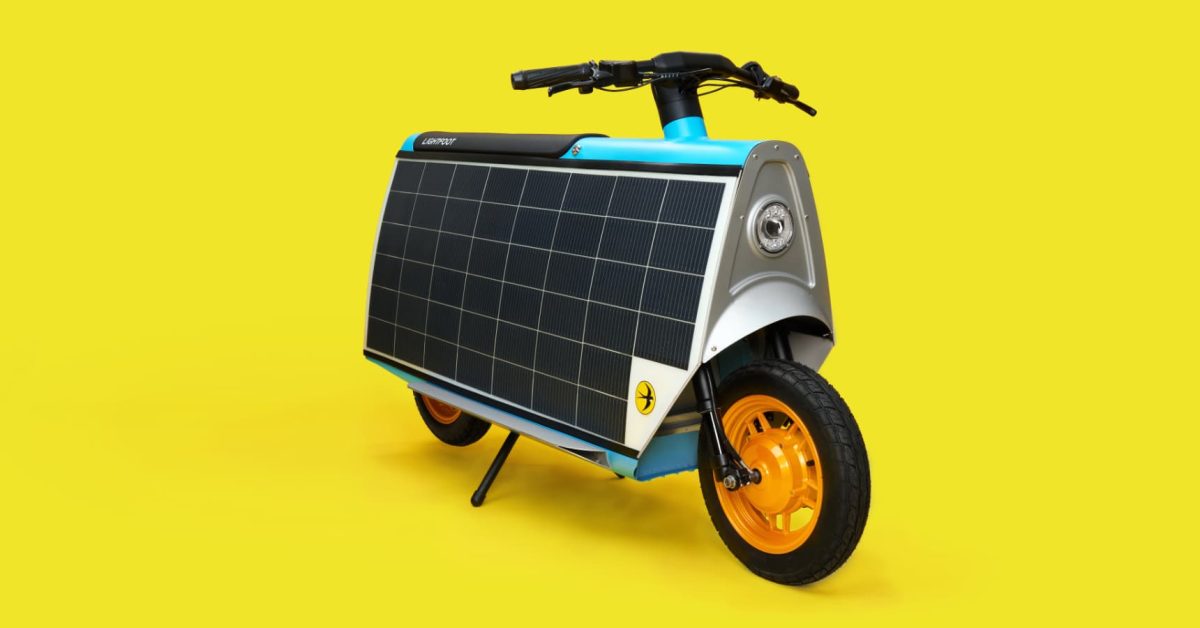
San Francisco research and development firm Otherlab has moved its sun-charged Lightfoot scooter from prototype to production, opening reservations for a first batch of 100 Launch Edition units. Priced at 100 deposit to hold a spot in line, and the earliest examples will arrive in sky blue or solar orange. The reveal caps a development arc that stretches back roughly two years, when the concept was first shown to the public.
The Lightfoot’s defining feature is its bodywork: two 120W solar panels are molded directly into the flanks, creating a 240W array that Otherlab says can replenish between three and four miles of range every hour of strong sunlight, or as much as 18 miles over a full day outdoors. Pair that with a 52V, 1,560Wh battery rated for roughly 37 miles of range, and a rider covering about five miles each way could, in theory, meet nearly all their daily energy needs without ever reaching for a cable. A 230W onboard charger still allows a conventional wall-outlet top-up in about four hours when the weather refuses to cooperate.
Performance is deliberately modest. A pair of 750W nominal geared hub motors, one per wheel and each peaking at 1,000W, deliver a claimed 160 Nm of combined torque, which should make short work of urban inclines while keeping speed under 20 mph. The chassis rides on a 70mm inverted front fork and a 45mm rear coil-over shock, stops via Tektro hydraulic discs with 160mm rotors, and rolls on chunky 14 x 3.2-inch tires. It is not a lightweight, though: the Lightfoot tips the scales at 141 pounds with a 48-inch wheelbase.
What that bulk buys is practicality. A 45-liter lockable, weatherproof compartment sits inside the body and Otherlab says it swallows three grocery bags, while the long bench seat is shaped for two riders, so a shopping run does not have to be traded against carrying a passenger home. Equipment includes a 2,000-lumen headlight, an accelerometer-triggered taillight, a 120 dB horn, a Bluetooth display, regenerative braking, and a lockable center stand.
The regulatory picture is less tidy. Otherlab markets the Lightfoot for both streets and bike lanes and says no license or registration is required, but micromobility rules differ widely between states and cities, so buyers should verify local law before assuming a sub-20 mph machine belongs wherever a bicycle goes. At $4,495 the Lightfoot costs well above many seated scooters in its speed class, and it makes little financial sense for anyone who simply wants two wheels and a 20 mph cruise. The case for it rests on low daily mileage, somewhere sunny to park, and an appetite for a vehicle that looks like nothing else on the road.
What do you think?