
HyFlux's Superconducting Motor Looks Plausible — the Hydrogen Airliner Around It Is the Real Test
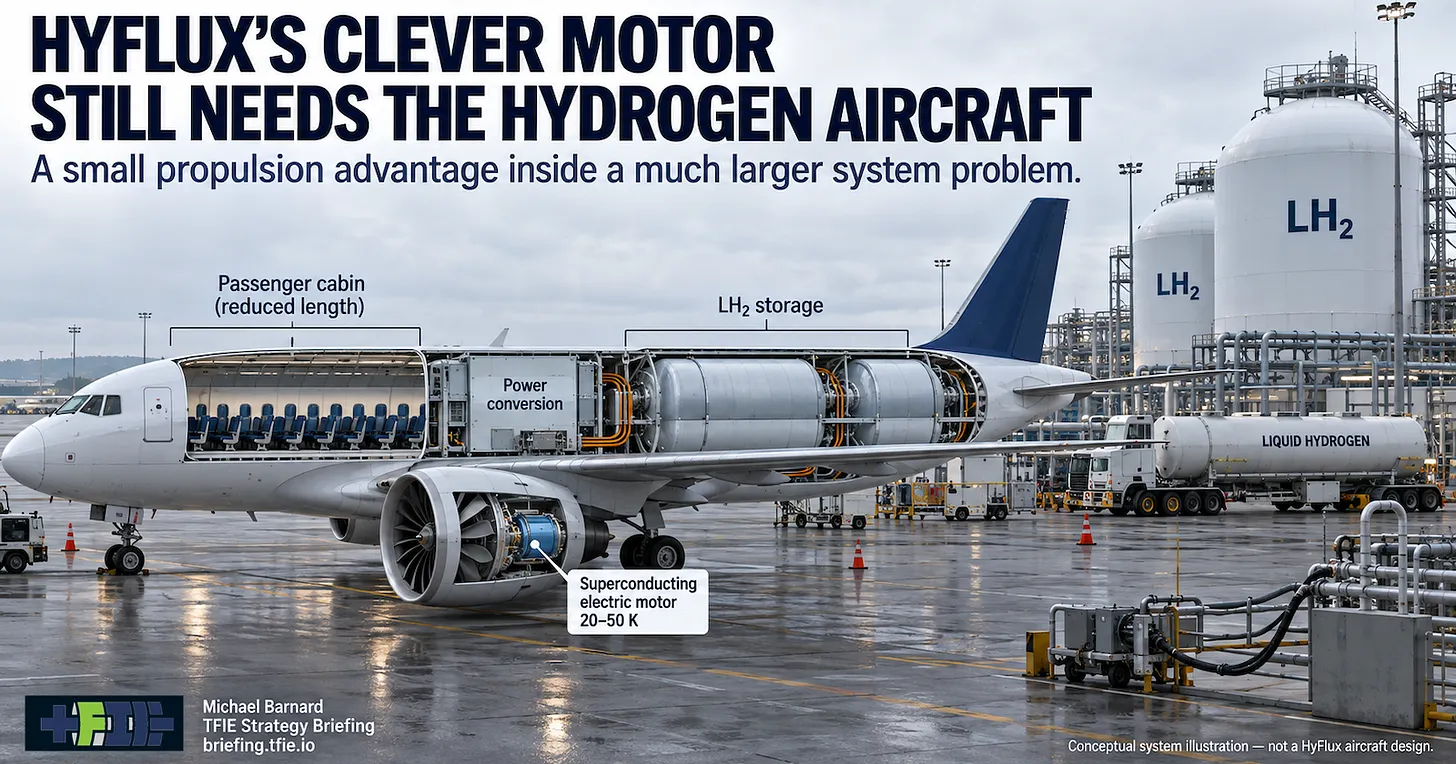
HyFlux, a UK engineering firm, has put forward a genuinely intriguing hydrogen-aviation concept: use the extreme cold of liquid hydrogen already on board a future aircraft as the cooling medium for a fully superconducting electric motor. Because superconductors can carry enormous current densities, such a machine could, in theory, deliver far more power per kilogram than a conventional motor. HyFlux has floated figures above 20 kW/kg while aiming at multi-megawatt propulsion, a striking number when set beside NASA Glenn’s High-Efficiency Megawatt Motor effort, which targets roughly 16 kW/kg at 99% efficiency in a partially superconducting design.
On first principles, then, dismissing the idea outright would be a mistake. The better questions are about what the headline number actually covers. How much extra mass does the motor pick up once you add the hardware required to turn it into a flight-ready propulsion installation? What has been proven in the gap between earlier 100 kW demonstrator work and the multi-megawatt architecture now being discussed? And how does operating in a cryogenic environment change the maintenance and reliability picture for an airline? Above all of that sits a market question: will commercial liquid-hydrogen aviation ever grow large enough to support a supplier of such a specialised component?
The investment case, in other words, rests on two separate wagers. The first is technical — that a fully superconducting aircraft motor keeps its exceptional mass advantage once all the surrounding equipment is included. The second is far bigger: that liquid-hydrogen commercial aircraft get designed, certified, built and deployed in meaningful numbers at all. A conventional motor, inverter or controller can find work across several electrification markets even if one aircraft programme stalls. HyFlux’s aviation play only pays off in a world where hydrogen passenger flight has already cleared a series of difficult hurdles.
Reassessing hydrogen passenger aviation as a complete system — as this analyst did in 2023 and again in September 2026 after three more years of airframe and certification work — some earlier objections no longer hold. Cryogenic tank geometries are more flexible than sphere-based arguments suggested, regulators are building certification routes, and there is no sound basis for claiming hydrogen airliners simply cannot fly. What remains is the harder, less dramatic question: can a finished aircraft preserve a useful passenger, baggage, range and reserve mission, reach repeat production, and find enough airports able to supply large volumes of cryogenic hydrogen reliably enough for scheduled service? The probability of that by 2050 is judged to be under 1%.
A better motor does help with one part of the equation, because propulsion mass competes directly with payload and range. It does nothing about hydrogen’s low volumetric energy density, the need for protected cryogenic tanks, the knock-on effects on layout and centre of gravity, or the requirement for an entirely new airport fuel supply chain — one that stops resembling today’s industrial-gas market and starts looking like major energy infrastructure. The airframe and the airport must therefore advance together, and a single improved component does not break that dependency. Nor does hydrogen compete only against synthetic kerosene; battery-electric aircraft are climbing from shorter ranges, hybrids extend that reach, and conventional turbines can burn sustainable liquid fuels without rebuilding the fuel architecture. If HyFlux can show its propulsion architecture holds an exceptional advantage in a flight-representative installed system, that would materially strengthen its technical case. Public evidence has not yet established that result, and scaling a promising motor architecture into a certifiable multi-megawatt product is far from routine.
What do you think?