
HUBER+SUHNER Pitches Corrugated-Free RADOX High Voltage Cables for EVs
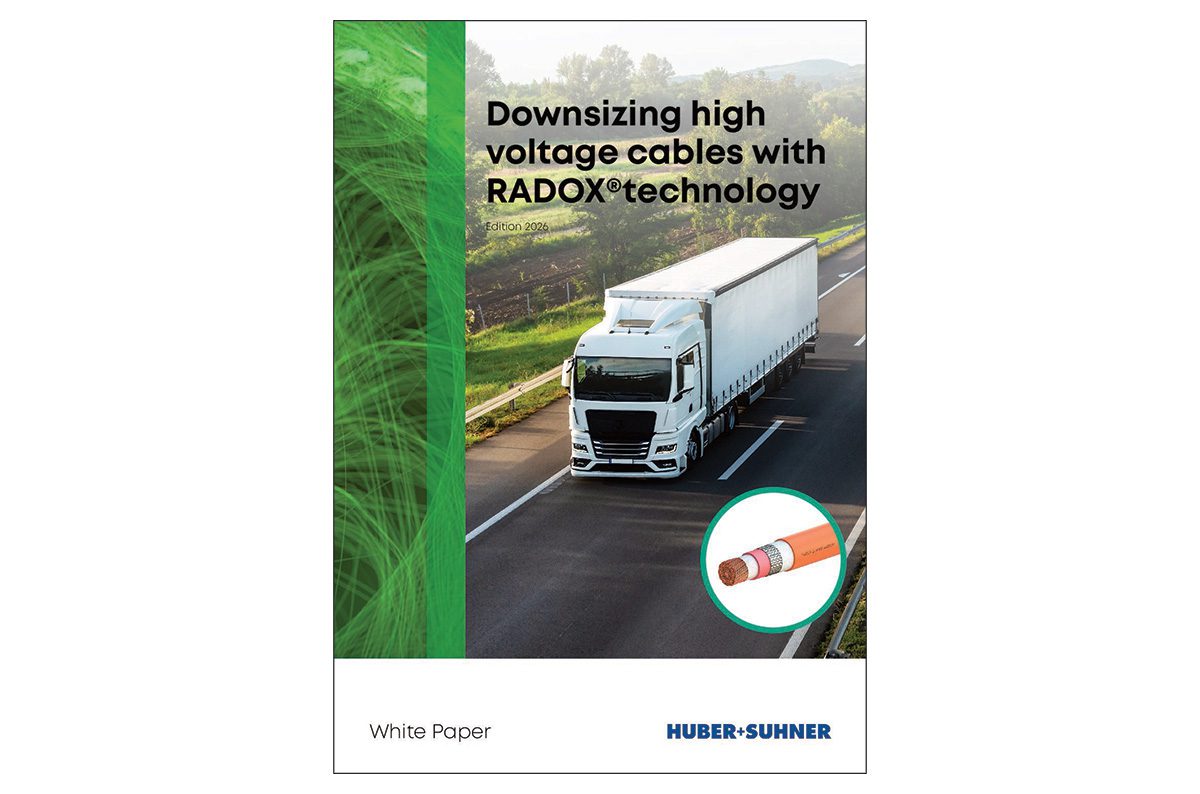
High voltage cabling forms the electrical backbone of every electric vehicle, and for years engineers have leaned on corrugated tubing to shield those conductors from abrasion, chemicals and moisture. HUBER+SUHNER now argues that this protective sleeve may have outlived its usefulness, and is promoting its RADOX cable family as a lighter, cooler-running alternative.
The company points to a familiar tension in EV design: automakers want lighter and more tightly packaged vehicle architectures to stretch driving range and lift overall efficiency. Corrugated tubing works against that goal in two ways. Depending on the application, the conduit can account for somewhere between 20% and 60% of the total weight of a cable assembly, and because it wraps the conductor so closely it also traps heat, holding temperatures higher and limiting how quickly that heat can escape. Rising temperatures in turn mean greater power losses and hastened cable ageing.
The physics behind that ageing is well established. HUBER+SUHNER cites the Arrhenius Rule, which holds that roughly every 10°C increase can cut insulation life by about half — a strong argument, the company says, for moving past the corrugated approach.
RADOX cables take a different route. Their insulation and jacketing materials are cross-linked using an electron beam, a treatment that allows continuous operation at temperatures up to 150°C while resisting abrasion, fluids and heat. Because the cable manages its own thermal load, it can in many installation environments be routed in free air without any added corrugated tubing. In some cases this lets designers swap a conventional 95 mm² conductor inside a corrugated tube for a 70 mm² RADOX cable and still hit the same ampacity, voltage rating and safety targets.
Shedding that size and weight opens up packaging room and design freedom, and the improved heat dissipation that comes with free-air routing supports more adaptable architectures overall. HUBER+SUHNER has published a white paper that walks through the real-world implications of the shift — what the change means for current-carrying capacity, durability and routing, and how a cable-integrated approach compares with traditional corrugated protection.
What do you think?