
Honda to Trial In-Road Wireless Charging on a Tokyo Highway Stretch in 2027
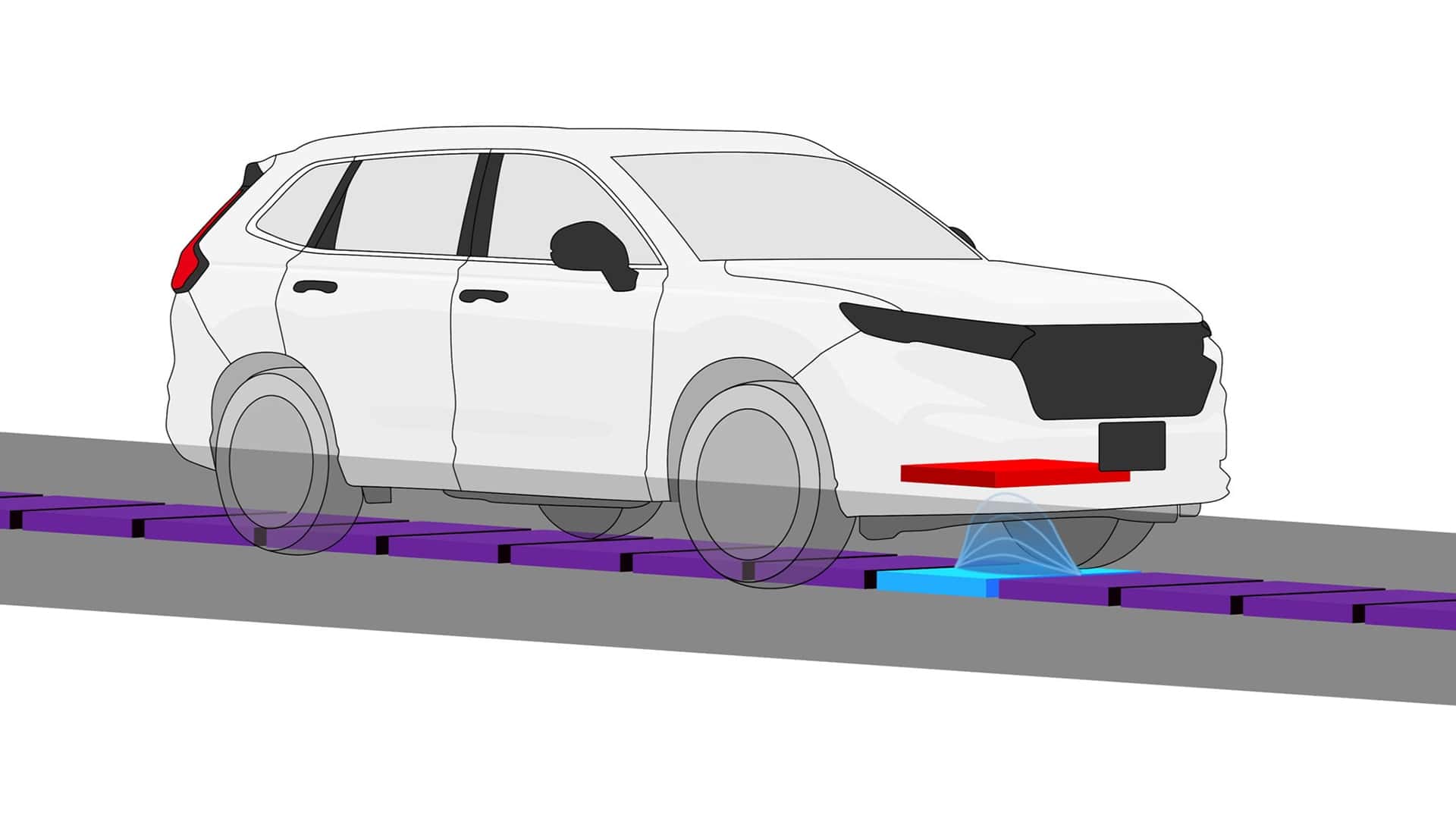
Honda has confirmed plans to begin public-road testing of dynamic wireless charging next year, starting with a short section of highway in Chiba prefecture, just outside Tokyo. The stretch measures roughly 300 meters, and the company intends to install the necessary hardware before putting the system through real-world demonstrations. Honda frames this first phase as “demonstration testing” rather than a commercial launch, and it will be carried out through the automaker’s research and development arm together with Taisei, a Japanese construction and engineering firm.
The technology itself is the more intriguing part. Hardware buried in the roadway wirelessly transfers power to vehicles as they move, with Honda quoting an output of up to 150 kilowatts while a vehicle travels at 75 mph. That is a fundamentally different proposition from the stationary wireless pads already offered by Tesla and Porsche, which require a car to be parked. Honda’s system is designed to work with both passenger cars and large commercial vehicles, and the company’s initial focus is on the latter — long-haul trucks, buses and other high-utilization fleets that need continuous uptime and cover heavy mileage every day.
Honda’s chief engineer of R&D, Taku Ueda, has said the approach could allow future EVs to carry fewer battery cells. That prospect matters because batteries remain the single largest cost driver in an electric vehicle, and their weight feeds into both efficiency losses and road wear. In theory, a car with a smaller pack could still cover comparable distances if it draws power continuously while rolling, and Ueda suggested the technology could also ease charging anxiety among Japanese drivers. Honda has not disclosed cost figures, vehicle partners or a firm timeline beyond the 2027 test window.
Honda is not the first to pursue this idea. Electreon, an Israeli company specializing in wireless charging infrastructure, is the sector’s most prominent player and has already installed a short wireless-charging road segment in Detroit. Other automakers and government-backed programs have explored similar concepts over the years with mixed results. The challenge has consistently been infrastructure cost, standardization and the sheer complexity of retrofitting public roads rather than the charging hardware inside the vehicle.
What makes Honda’s effort notable is the scale of the ecosystem it would require. Charging a moving vehicle demands cooperation between carmakers, road operators, utilities and regulators — a coordination problem far larger than any single manufacturer can solve alone. If the Chiba trial validates the concept for commercial fleets, it could open doors for passenger vehicles later, though Honda is careful not to promise that. Meanwhile, the industry continues to develop faster plug-in charging and battery-swapping in parallel, and Honda’s move suggests the company expects wireless charging to be one of several answers rather than the only one.
What do you think?