
GWM's 2027 Tank 500 Gets a Brain Transplant, but the Price Tag Stays Put
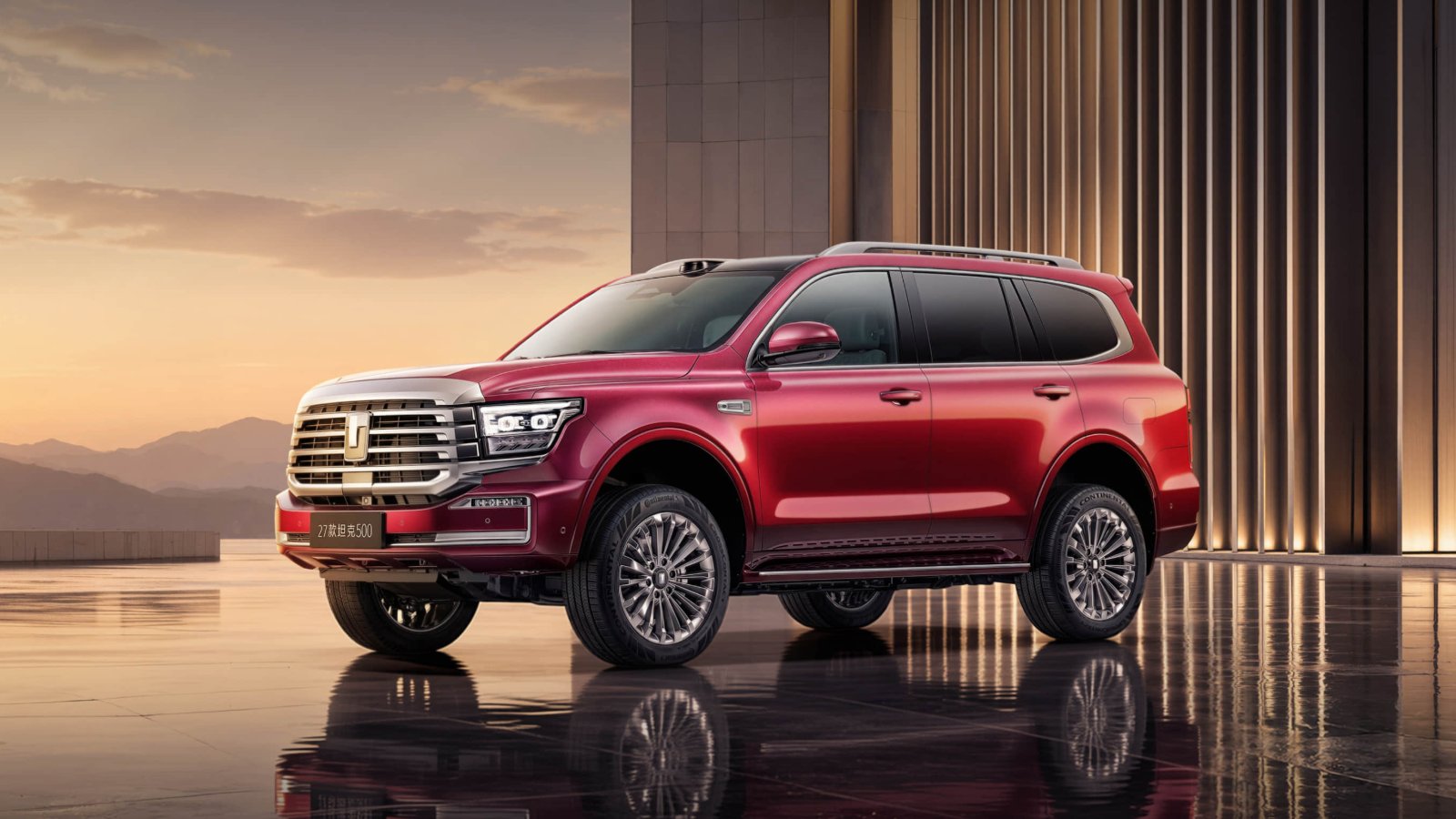
GWM rolled out the 2027 Tank 500 on October 23, and the headline isn’t under the hood — it’s behind the windshield. The off-road SUV picks up a heavily reworked driver-assistance suite and a fresher cabin, while its plug-in hybrid and gasoline powertrains carry over untouched.
Pricing holds steady at 335,000 to 375,000 yuan ($49,866 to about $55,800), the same band as the facelift that landed in August 2025. For a model-year refresh in a crowded market, that’s a deliberate play: add tech, don’t touch the sticker.
Three Flavors, One Familiar Price Ladder
The lineup splits into three powertrain choices — Hi4-T, Hi4-Z and a 3.0T gasoline unit:
- Hi4-T base: 335,000 yuan
- Hi4-T Zhixiang: 355,000 yuan
- Hi4-Z Zhixiang: 375,000 yuan
- 3.0T gasoline, 5-seat: 355,000 yuan
- 3.0T gasoline, 7-seat: 363,000 yuan
The gasoline version pairs its 3.0T engine with a 48V mild-hybrid setup and is the only way to get seven seats — the plug-in hybrids stick to five.
Tank counts 296 changes across hardware, software and safety redundancy, and the bulk of them cluster around driver assistance, cabin comfort and safety backups.
Coffee Pilot 4 Arrives With Nvidia Muscle
The two Zhixiang plug-in hybrids are the tech flagships here. They run GWM’s Coffee Pilot 4 system, built on Nvidia’s Thor-U chip alongside a VLA (Vision-Language-Action) model and LiDAR.
Key Specs: Nvidia Thor-U chip · 700 TOPS compute · 1 LiDAR · 3 mm-wave radars · 12 ultrasonic sensors · 11 cameras
That hardware unlocks urban and highway NOA, parking-space-to-parking-space assisted driving and voice control of vehicle functions. Step down to the base Hi4-T or the 3.0T, and you get Coffee Pilot 2 — no LiDAR, no frills.
Worth noting: the pricier plug-in hybrids from August 2025 ran Nvidia’s Orin-X and the third-generation Coffee Pilot Ultra. The 2027 car leapfrogs its own predecessor.
Inside, buyers get dual 15.6-inch displays, a 22-speaker audio system, power-folding front leg rests, rear tray tables and a bed mode. It’s a cabin that leans hard into long-haul comfort rather than pure utilitarianism.
Powertrains Stand Pat
The mechanicals are unchanged. The Hi4-T marries a 2.0-liter turbo four to a single motor and a 9HAT gearbox for a combined 310 kW (416 hp), tuned for off-road duty. Its 37.1-kWh battery delivers 110 km of WLTC electric range.
The Hi4-Z goes further: a 2.0-liter turbo plus two electric motors and a 3-speed DHT, for a combined 635 kW. A 59.05-kWh pack stretches electric range to 201 km on the WLTC cycle.
Sales Pressure Is the Real Backdrop
The refresh lands at an awkward moment for Tank. September deliveries slid 29.21% year-on-year to 15,178 units, and the first nine months of 2026 closed at 142,796 vehicles — down 13.53%.
The monthly numbers tell the story: June 2026 came in at 15,713, July at 17,228, August at 17,737. Compare that to the 20,000-plus months Tank was stringing together through much of 2025, and the trend line is unmistakable.
So this is less a celebration of new tech and more a rearguard action. GWM is betting that a smarter, more comfortable Tank 500 can pull buyers back — without resorting to a price cut that would dent margins. Whether 296 upgrades are enough to reverse a double-digit slide is the question nobody at Tank wants to answer out loud just yet.
Source: CnEVPost
What do you think?