
France and Germany's EV Rule Rollback Branded a 'Historic Mistake' for Europe's Auto Industry
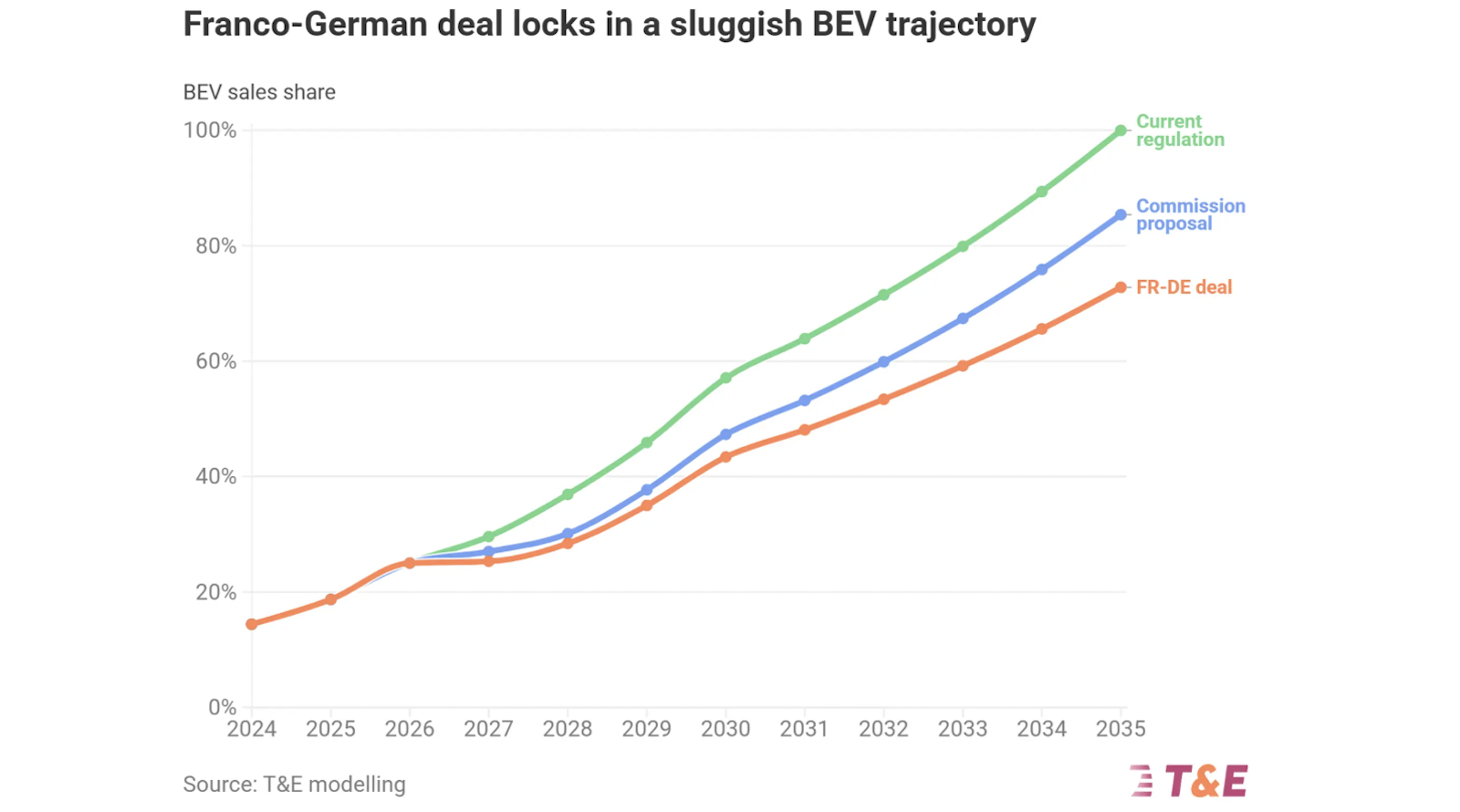
A pact between Paris and Berlin to soften the European Union’s car CO₂ rules and local-content requirements has drawn sharp condemnation from Transport & Environment (T&E), which calls the move a “historic mistake” that could undermine both Europe’s climate goals and its position in the global electric vehicle race.
The agreement, according to T&E, would ease the bloc’s CO₂ standards for cars and weaken the industrial added value (IAA) provisions governing where battery components must be sourced. Perhaps most controversially, it would let vehicles assembled inside the EU — even those fitted with Chinese-made batteries — carry a “Made-in-EU” label.
Weaker EV supply targets — T&E calculates the deal would drop the share of EVs supplied under current rules from 57% to 43% by 2030, slowing the market’s electric shift just as affordable models are starting to arrive. A loophole for Chinese cells — Cars built in Europe with Chinese battery packs would qualify for EU branding, a scenario T&E says threatens jobs across the continent’s battery supply chain. Modest local-content thresholds — The proposal reportedly sets European cell sourcing at just 10% in 2028–2029, rising to 20% in 2030–2031 — far below the more than 50% of cells already made in Europe in 2025. Gigafactory risk — T&E warns the low bar endangers 164 GWh of European battery capacity in 2027 and 254 GWh by 2030 by removing demand certainty for manufacturers.
Anna Krajinska, a senior director at T&E, argued that French and German leaders present the deal as a job-saving measure, but that it may instead be the arrangement that “buries” Europe’s auto industry — particularly with drivers facing record fuel prices and Chinese competitors pressing hard on price and volume.
The group is urging members of the European Parliament and EU governments to reject any further dilution of the CO₂ standards, to back meaningful Made-in-Europe rules, and to set ambitious electrification targets for large corporate fleets — a lever it says would secure growing demand for European-made batteries starting in 2027. Whether lawmakers heed that call will shape how quickly the continent’s battery supply chain matures — and whether Europe’s carmakers can keep pace globally.
Source: CleanTechnica
What do you think?