
Ford V8 Swap: A 1964 Jaguar E-Type Roadster That Prioritizes Driving Over Purity
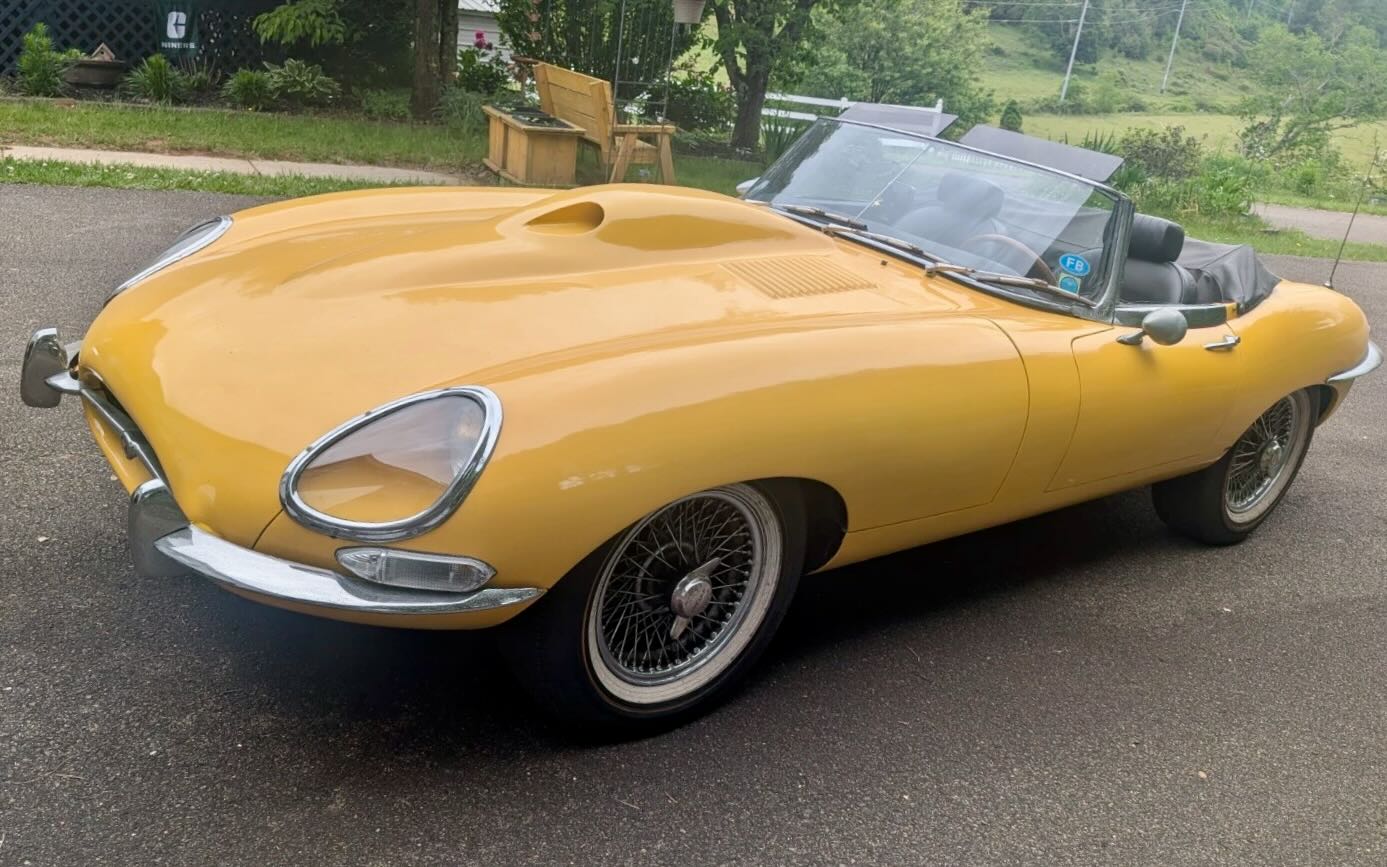
Few classics carry as much mythology as the Jaguar E-Type. Among the stories that cling to it is the oft-repeated claim that Enzo Ferrari once called it the most beautiful car ever built — a line repeated so often that few stop to ask whether he ever actually said it publicly. What is far better documented is the flip side of that beauty: an inline-six that can be demanding and expensive to keep healthy. This 1964 E-Type Roadster, currently listed on eBay out of West Jefferson, North Carolina, sidesteps that problem entirely, because the Jaguar six is gone and a Ford 289 V8 now sits beneath a noticeably bulged hood. Bidding currently sits at $10,000, with a Buy It Now price of $40,000.
The original XK inline-six is, by most accounts, a lovely engine — smooth and remarkably strong for a design that dates to the 1940s. Depending on exactly when in 1964 this car was assembled, it would have left the factory with either the 3.8- or the 4.2-liter version, both rated around 265 horsepower, with the larger unit offering more torque. The trade-off is complexity: a valvetrain far more intricate than a simple pushrod V8, which translates into more frequent attention and pricier repairs when something lets go. The Ford 289, by contrast, is about as straightforward as V8s get, and keeping one running is cheap and easy by comparison.
Swapping an E-Type is not automatically a disaster, but how it was done matters enormously. Some conversions involve cutting into the firewall and engine bay to make room, and that kind of structural surgery is effectively permanent — you cannot simply undo it later. This car reportedly avoids that fate, having been converted using a Logan Engineering kit that required no cutting. Apart from that hood scoop, returning it to Jaguar power would mostly be a matter of sourcing a drivetrain. The seller gives no details on how the 289 is tuned, so output could realistically land anywhere between roughly 200 and 300 horsepower. It may not make the car quicker than stock, but it should sound considerably better and cost far less to service.
Inside, things look largely factory, though not entirely correct. Most E-Types shipped with a manual, and automatics were available on the option sheet, but the shifter here is clearly not a Jaguar piece. The seats also do not match this model year, appearing to resemble units from a later Jaguar, though their origin is unstated. On the plus side, the seller notes the carpets are in good condition, the top was replaced a few years back, and the fuel gauge is currently inoperative. Taken together, the cabin reads as usable rather than restored.
Purists will argue — reasonably — that the original drivetrain belongs in a car like this, and the V8 certainly does not help its value. But the counterargument is easy to follow: similar power, roughly comparable weight, and an engine that costs a fraction to replace if it fails. For someone who intends to actually drive their E-Type hard rather than trailer it to shows, that math is appealing. The main sticking point is the hood scoop, which sits high enough to complicate an already difficult view forward in tight parking lots, and it is not something you can easily eliminate. Aesthetics aside, the appeal here is simple: a beautiful British roadster you can enjoy without treating the engine as a fragile heirloom.
What do you think?