
Ford GT90: The 1990s Concept That Imagined America's Hypercar
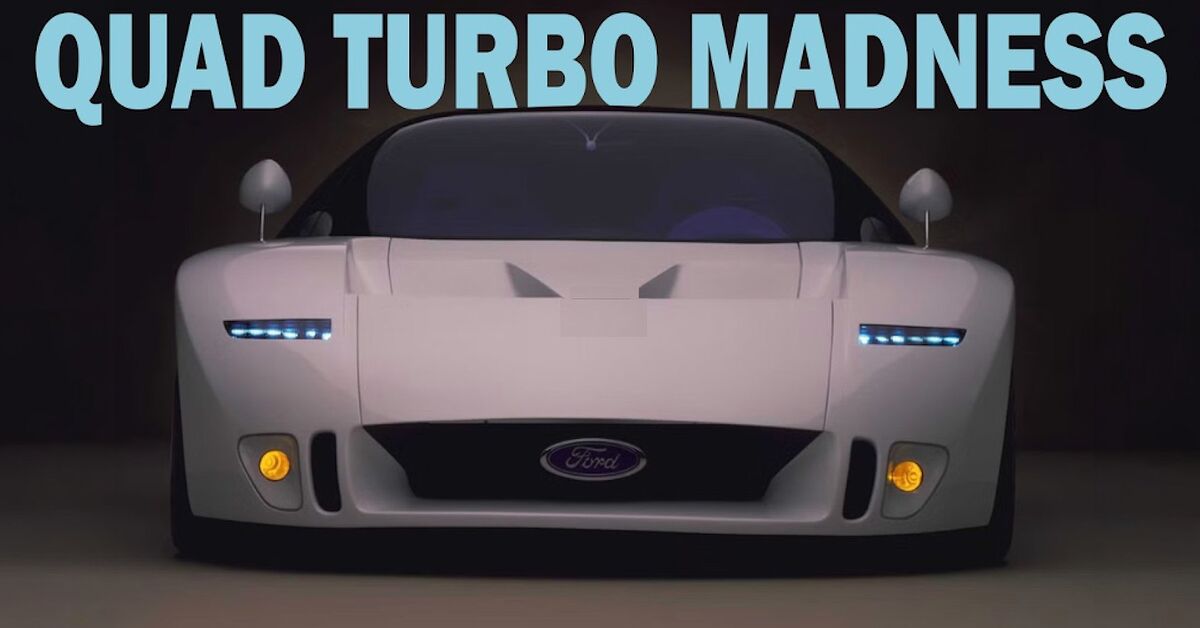
When Ford rolled the GT90 onto the floor of the 1995 Detroit Auto Show, restraint was clearly not on the agenda. Here was a low, angular machine finished in white with blue-tinted glass, a set of triangular exhaust outlets, and a spec sheet that read less like a specification and more like a dare: a claimed 720 horsepower and a purported 253-mph top speed.
The timing made the statement even louder. McLaren’s F1 was already rewriting the supercar rulebook, and Ferrari’s F50 was about to arrive with Formula One theatrics attached. Ford, a company best known at the time for the Taurus, Escort and F-Series, decided to answer on the same stage. The GT90 was never a styling exercise for a future production model; it was Ford proving it could dream at the same scale as Europe’s most exotic marques.
What made the project unusual was where much of the hardware came from. Ford owned Jaguar in that era, and the GT90 leaned on engineering linked to the XJ220, including chassis and suspension architecture and a five-speed manual transmission from that orbit. The result was a curious hybrid: an American concept wrapped around British supercar bones. Under the skin sat a 90-degree V12 derived from Ford’s modular engine family, a 6.0-liter-style unit breathing through four Garrett turbochargers, with Roush involved in development and testing. Quoted figures included 660 lb-ft of torque, a redline near 6,300 rpm, 0–60 mph in a claimed 3.1 seconds and 0–100 mph in 6.2 seconds. Those numbers deserve caution, since the car was a concept rather than a finished production vehicle.
The heat generated by the exhaust was severe enough that Ford wrapped the rear outlets in ceramic shielding, a reminder that extreme performance brings practical headaches. Special Vehicle Operations reportedly assembled the car in roughly six months, which explains both its rough edges and its distinct character. Structurally it was more than a mockup: carbon-fiber bodywork sat over an aluminum honeycomb structure, paired with bespoke powertrain engineering.
The GT90 also served as an early showcase for Ford’s New Edge design language, arriving well before it appeared on mainstream products like the Focus and Cougar. Its sharp creases, dramatic cut surfaces and gullwing-style doors made it look like it had been designed for a virtual world, which is partly why it fit so naturally into video games of the period. The interior followed suit with blue tones and sculptural, almost digital-looking controls.
Turning the car into something a customer could actually buy would have demanded solutions to heat management, emissions, reliability, refinement, warranty obligations, production engineering, cost and dealer support. The Jaguar XJ220’s own troubled path to market offered a cautionary parallel. The GT90’s real legacy is therefore not on the road but in what it represented. When Ford finally built the 2005 Ford GT, it chose nostalgia; the GT90 showed the radically futuristic alternative the company could have pursued. It stands as a snapshot of a moment when Ford was willing to imagine an American supercar with almost no regard for conventional limits.
What do you think?