
Ford Funds 100 MW Michigan Solar Farm to Power Its Home-State Plants
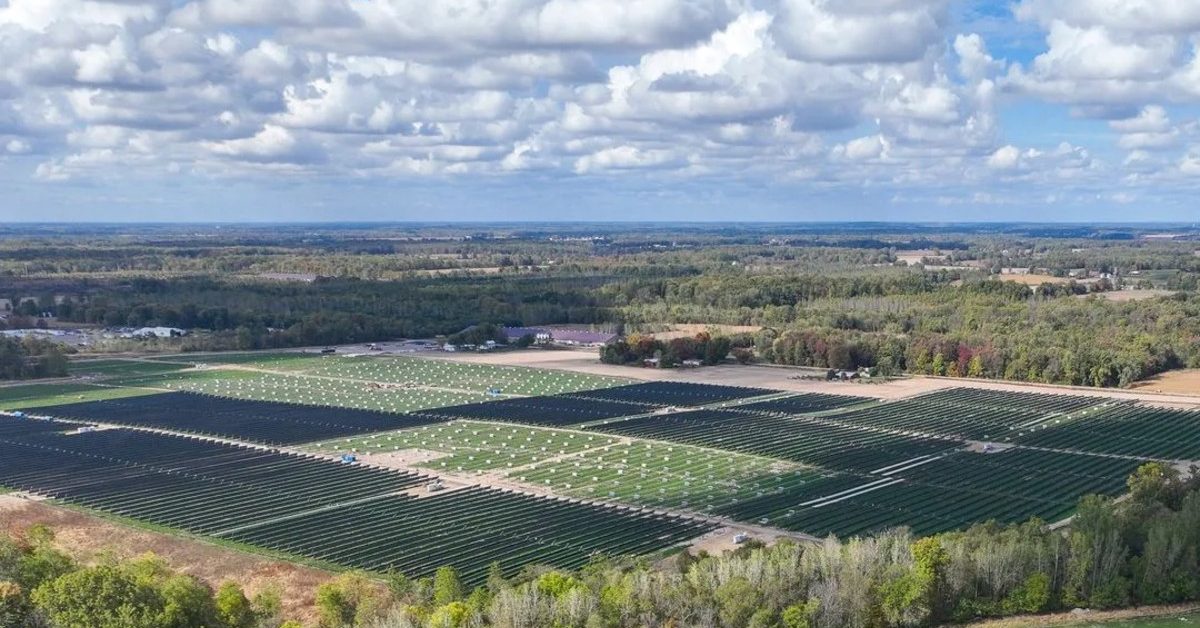
Ford has taken another step toward cleaning up the electricity behind its Michigan manufacturing operations. DTE Energy, based in Detroit, has finished building a 100-megawatt solar installation near Coldwater, Michigan, and Ford is paying for it — to the tune of $194 million — through its participation in the utility’s voluntary renewable energy program, CleanVision MIGreenPower.
Cold Creek Solar Park, as the project is known, produces enough electricity to cover the equivalent demand of somewhere between 23,000 and 25,000 Michigan households. Ground was broken on the site in April 2025, and it stands as the first in a series of DTE developments intended to underwrite Ford’s renewable electricity pledge within the state. Back in 2022, the automaker committed to buying as much as 650 MW of renewable power through MIGreenPower, a scheme that lets both households and businesses align their consumption with Michigan-generated wind and solar while financing new projects.
The headline goal for Ford is to build every vehicle it assembles in Michigan using the equivalent of fully carbon-free electricity by the close of 2027, per DTE’s latest statement. That target has slipped, however: when the two companies first announced their agreement in August 2022, the deadline was set for 2025. The new announcement offers no explanation for the shift.
Beyond Ford’s factories, the utility points to community-level upside from MIGreenPower-backed construction — local employment and additional tax revenue for the towns hosting the projects — though it hasn’t put specific numbers behind those claims. At the time the broader Ford deal was unveiled, DTE projected that building out the solar arrays would support 250 temporary construction roles and 10 permanent ones, and suggested host communities could direct new tax income toward roads, schools, libraries, and first responders. Those figures applied to the wider buildout rather than Cold Creek on its own.
The Michigan arrangement fits into a larger corporate strategy at Ford: sourcing 100% carbon-free electricity across its global manufacturing footprint by 2035, and achieving carbon neutrality spanning its vehicles, production, and supply chain no later than 2050.
What do you think?