
Europe's Hydrogen Truck Bet Risks Repeating South Korea's Empty-Station Mistake
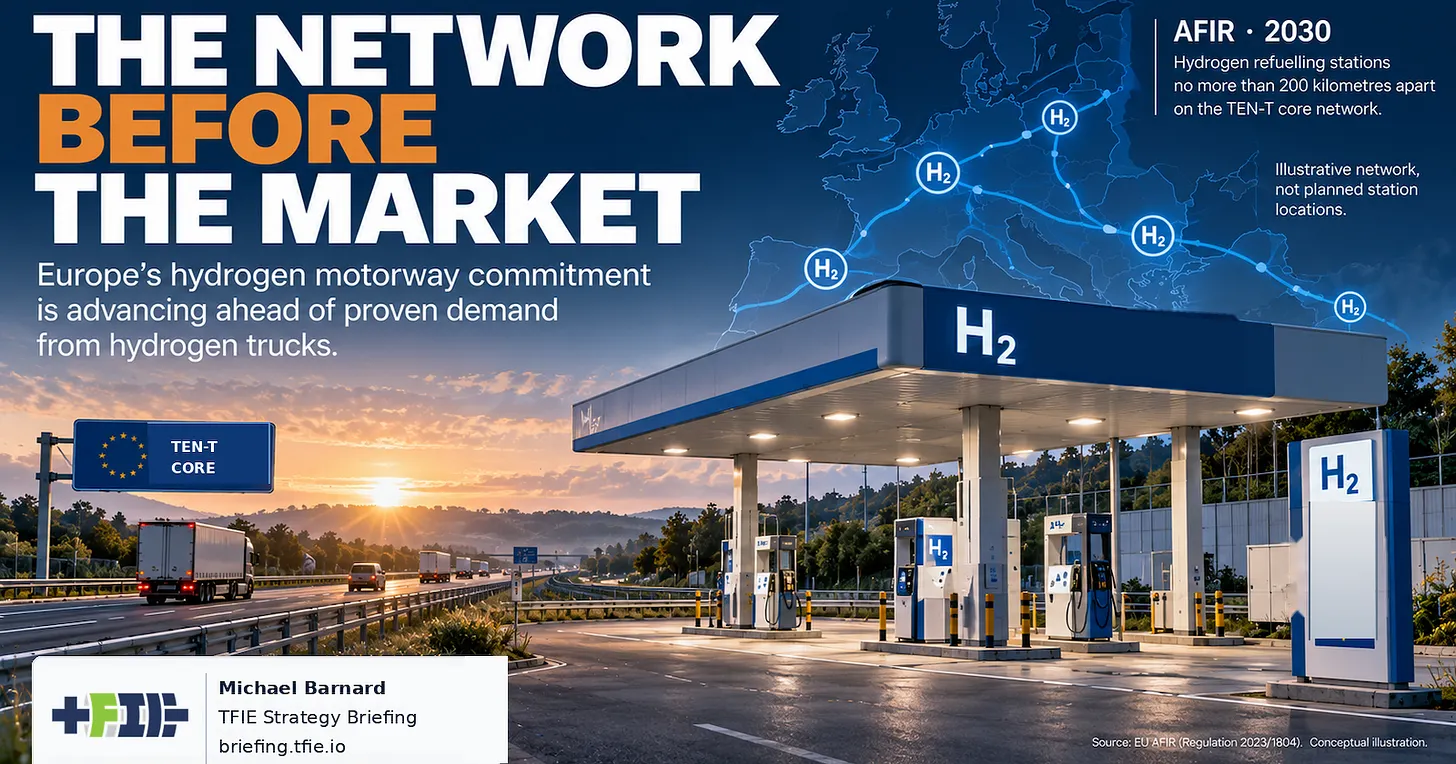
Europe is rolling out hydrogen refuelling infrastructure on a schedule that its own truck market may not be ready to fill. Under the Alternative Fuels Infrastructure Regulation (AFIR), member states are expected to place hydrogen stations along key highway routes by 2030, spaced roughly every 200 kilometres, with extra capacity added around major urban hubs. The logic behind the mandate is that a visible network will give hauliers the confidence to switch to fuel-cell trucks.
South Korea already ran that experiment, and the results were sobering. The country poured public money into a hydrogen station build-out ahead of real demand, and when the trucks failed to materialise in the expected numbers, several stations sat underused. The gap between installed capacity and actual refuelling activity became a political liability, not just an economic one.
The core problem is sequencing. A refuelling network only pays for itself when there is a dense enough fleet of vehicles to use it, but fleets will not commit to fuel-cell trucks until they know the stations exist and work reliably. Europe’s regulation tries to break that deadlock by legislating the stations first. Critics argue this inverts the normal order of infrastructure investment, and South Korea’s experience suggests the inversion is costly.
The comparison with battery-electric trucks is unavoidable. Electric haulage can lean on a charging network that also serves passenger cars, vans and buses, spreading the cost across a far larger user base. Hydrogen stations, by contrast, serve a narrow slice of vehicles and require dedicated, expensive equipment with low utilisation rates in the early years.
None of this means hydrogen has no future in heavy transport. Long-haul routes, high payloads and rapid refuelling remain genuine advantages in certain duty cycles. But the South Korean case is a warning that building the pipes before the trucks arrive can leave Europe with a well-mapped hydrogen corridor and very little traffic on it. The smarter path may be to let fleet demand guide where stations go, rather than mandating coverage on a fixed geopolitical timeline.
What do you think?