
Europe's EV Boom Hits a Record 31% Share as Tesla Sweeps the Podium
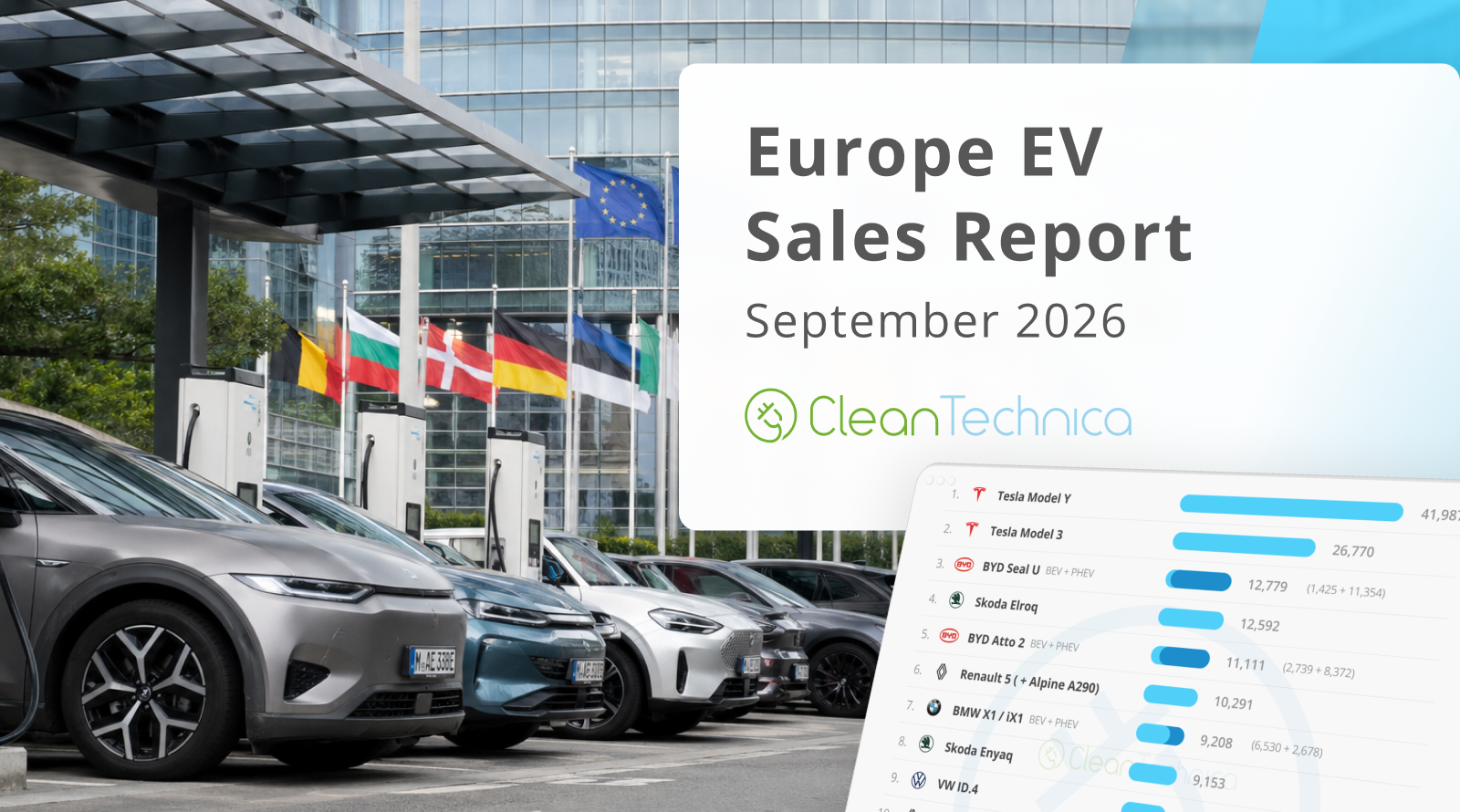
September 2026 will go down as the month Europe’s electric car market finally broke through. Fully electric passenger cars took 31% of the market, with 422,000 registrations — a 63% jump year over year and the fastest growth rate the continent has seen in more than three years.
Plug-in hybrids weren’t left behind either. They climbed 23% to a record 167,000 units, pushing the combined plug-in total to 590,000 cars and a 43% share of the overall market.
September Snapshot: 422,000 BEVs · 167,000 PHEVs · 31% BEV share · 43% combined plug-in share · 63% BEV growth YoY
And this isn’t a one-off spike. The year-to-date BEV share now sits at 25%, with plug-ins combined at 36% — already ahead of where the whole of 2025 finished (20% and 29% respectively).
The Old Guard Keeps Sliding
Petrol and diesel are fading fast. Gasoline held just 18% of September’s market, down 21% year over year, while diesel dropped to 4%, a 28% decline. Meanwhile, plugless hybrids grew a mere 5% against a market that expanded 10%.
The more telling signal: HEVs held a 34% share in September, compared with 36% a year earlier. That dip may mark the moment conventional hybrids started their long descent. If 2026 turns out to be the year of peak HEV, the obvious question is how close PHEVs are to their own ceiling.
Tesla Owns the Show
The headline result came from Tesla. The Model Y led the entire European market with 41,987 registrations, up 52% year over year and its strongest showing in four and a half years. The Berlin-built crossover topped the charts in Germany, France, Sweden, Norway, the Netherlands, Denmark, Switzerland, Finland, Ireland, Iceland and more.
Its sibling wasn’t far behind. The Model 3 posted 26,770 registrations, a 120% surge that put it second overall — only the second time Tesla has locked out the top two spots across all powertrains, the first being December 2022. Waiting lists for the decade-old sedan now stretch three to four months.
- Model Y: 41,987 units, +52% YoY, from roughly €40,000
- Model 3: 26,770 units, +120% YoY, from around €35,000
- BYD Seal U: record 12,779 units, third in the EV ranking
Value Beats Badges
Part of what’s driving this is price. With premium German midsize models now starting above €50,000, a gap has opened in the €40,000—50,000 band. Buyers are filling it with the Model Y, Model 3, Xpeng G6, Mazda 6e/CX-6e, Deepal S07, BYD Seal/Seal U, Leapmotor C10 and Zeekr 7 GT, among others.
These customers aren’t shopping for a badge. They want to cut running costs by moving from combustion to electric, and the numbers are doing the persuading.
Where Electrification Still Lags
The segment picture is uneven. The midsize class now has the Mercedes GLC in third place, with 59% of its sales coming from electric or plug-in variants. The A-segment has the Renault Twingo in second, and with the new Dacia Spring and a planned Volkswagen ID.Up on the way, small cars look set to electrify quickly.
The C-segment is getting there too: the VW Golf is 31% PHEV, the VW Tiguan 32% and the Jaecoo 7 47%. In the full-size class, the BMW 5 Series is 74% electrified across BEV and PHEV variants.
But the all-important B-segment remains the weak spot. None of its top three models offers a plug-in version, leaving Europe’s biggest volume category firmly in combustion territory.
That’s the gap to watch. The momentum is unmistakable, yet the mass-market heart of the continent hasn’t switched over — not by a long shot.
Photo: Tesla / CleanTechnica · Official Press Kit / Editorial (Editorial / Press Kit)
Source: CleanTechnica
Curious how this compares to other EVs? Try our comparison tool →What do you think?