
Chlorine-Doped Lithium-Sulphur Cells Could Push Energy Density Higher
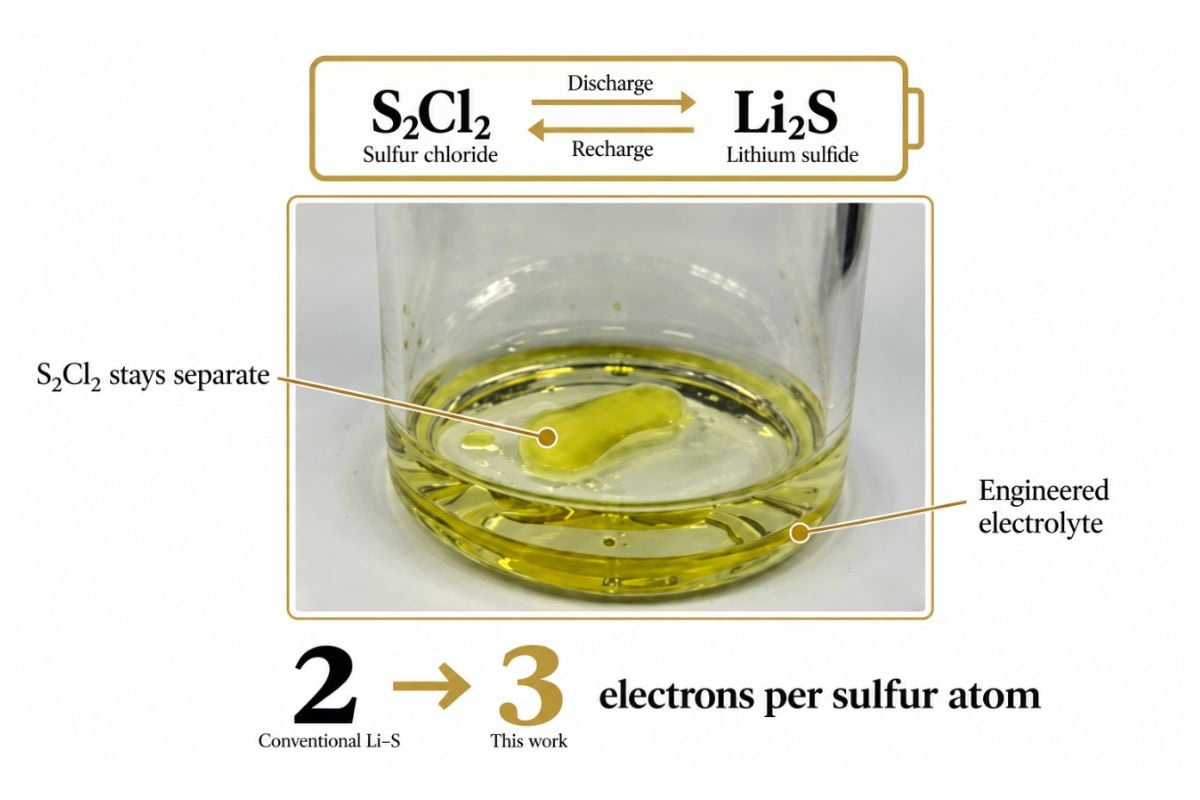
A joint research effort between Vanderbilt University and the University of Maryland has introduced a new cell chemistry for lithium-sulphur batteries, a technology long viewed as a promising but stubborn successor to today’s lithium-ion packs. According to the team, weaving chlorine into the cell design opens the door to extra electron transfer at elevated voltage, a combination that could translate into noticeably higher energy density than current chemistries allow.
Lithium-sulphur has been an attractive research target for years because sulphur is cheap, abundant and capable of storing a large amount of charge per unit of mass. The obstacle has always been practical: sulphur electrodes tend to degrade quickly, and the chemistry has historically struggled to deliver its theoretical promise across enough charge cycles to be useful in real vehicles. The researchers’ chlorine-based approach appears aimed squarely at that gap, using the halogen to unlock additional electrochemical activity rather than simply tweaking an existing recipe.
The significance for the automotive world is straightforward. Energy density is one of the core levers determining how far an electric vehicle can travel on a given battery mass, and how heavy the pack must be to hit a target range. If lithium-sulphur can be made to work reliably, it could offer a lighter, less material-intensive alternative to lithium-ion, easing pressure on supply chains that depend heavily on nickel and cobalt.
That said, this is laboratory-stage work. The announcement describes a promising cell chemistry and a mechanism for higher-voltage operation, not a production-ready battery. Questions that will decide whether the approach matters commercially — cycle life, manufacturing scalability, safety and cost at volume — remain open, and the path from a university result to a vehicle program is typically measured in years.
The research nonetheless adds to a broadening field of post-lithium-ion candidates, including solid-state and sodium-ion designs, all competing to define the next generation of EV energy storage. For now, the Vanderbilt and Maryland work is a data point suggesting that sulphur chemistry, long considered a distant prospect, may still have unexplored room to improve.
What do you think?