
China's September NEV Retail Sales Drop 16.7% Yet Set Record 67% Market Share
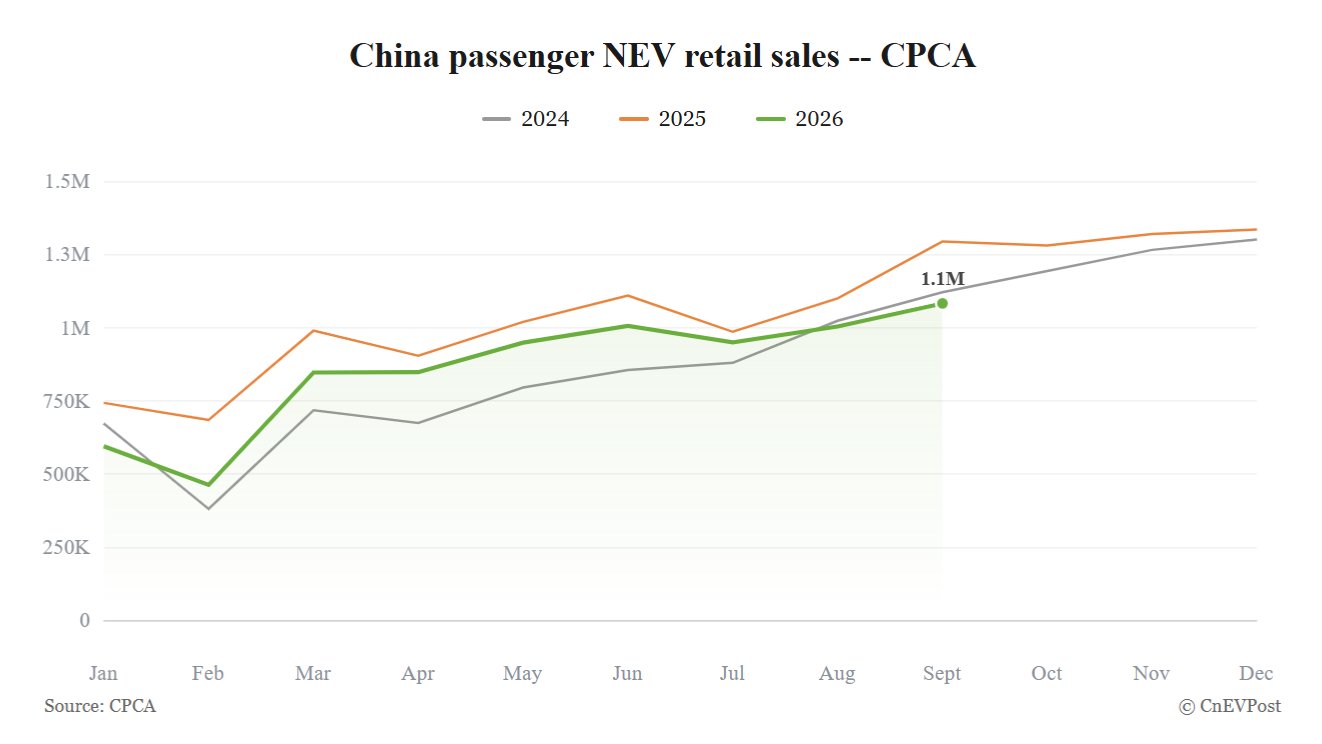
China’s new energy vehicle market delivered a contradictory picture in September, according to fresh figures from the China Passenger Car Association (CPCA). Retail deliveries of NEVs came in at 1.084 million units, a 16.7 percent slide compared with the same month a year earlier — the ninth straight month of annual declines — although volumes still climbed 7.8 percent over August. For the first three quarters combined, retail NEV sales reached 7.758 million, down 12.8 percent year-on-year.
What makes the month notable is the penetration story. NEVs captured a record 67.0 percent of all passenger car retail sales, an increase of 9.1 percentage points from a year ago and 1.7 points above August. The split by brand type is even more striking: domestic Chinese marques saw NEV penetration hit 84.5 percent, luxury brands reached 44.9 percent, while mainstream joint-venture brands sat at just 15.9 percent. Domestic brand NEV retail sales fell 19 percent year-on-year, joint-venture NEV volumes jumped 36 percent, and luxury NEV sales slipped 8 percent. Small A00-class electric models took a particularly hard hit, which the CPCA tied to unfavorable subsidy conditions.
Wholesale data tells a different story from the retail side. NEV wholesale shipments climbed 11.3 percent from a year earlier and 10 percent from August to 1.666 million units, pushing wholesale penetration to a record 65.4 percent — a 12-point improvement year-on-year. Battery electric vehicles were the only powertrain type to expand, rising 18.3 percent to 1.126 million units. Plug-in hybrids were essentially flat at 423,000 units, down 0.1 percent, and extended-range electric vehicles declined 4.0 percent to 117,000.
Exports remain the industry’s main engine of growth. Total passenger car exports rose 73.7 percent year-on-year to 917,000 units in September, equal to 36 percent of automakers’ passenger car sales. NEV exports alone surged 163.5 percent year-on-year, and 7.7 percent month-on-month, to 558,000 units, representing 60.8 percent of all passenger car exports — up 21 percentage points from a year earlier. NEV exports over the first nine months of 2026 totaled 3.887 million units, up 138.8 percent.
The broader Chinese passenger car market contracted sharply. Total retail sales fell 28.0 percent year-on-year to 1.618 million units, though that was 5.0 percent above August, with the nine-month total at 13.33 million units, down 21.7 percent. Gasoline vehicle retail sales dropped 43 percent year-on-year, including a 49 percent plunge for conventional gasoline models, while conventional hybrids managed a 25 percent gain. The CPCA blamed a high comparison base — last September featured both an early Mid-Autumn Festival holiday and a rush to beat expiring provincial subsidies — along with elevated oil prices weighing on gasoline demand, and AI-driven surges in memory and chip prices plus supply shortfalls that slowed contributions from newly launched NEV models.
BYD led the domestic retail NEV ranking with 246,816 units in September, followed by Geely Auto at 119,682 and Leapmotor at 78,202. Tesla came in fourth with 64,837, ahead of Changan Automobile at 61,732 and SAIC-GM-Wuling at 54,810. Chery recorded 46,860, SAIC Passenger Vehicle 40,280 and Xiaomi 40,015, while Huawei-backed HIMA moved 37,490 units, Nio 37,231, GWM 32,048, Li Auto 31,817 and Xpeng 30,599. Emerging EV manufacturers collectively held a 23.6 percent share of the retail market, up 3.4 percentage points year-on-year, driven largely by Leapmotor and Nio, with BEVs making up 75 percent of their sales versus 70 percent a year earlier. Looking to October, the CPCA expects the month’s 18 working days — unchanged from last year — to provide more selling time now that the Mid-Autumn holiday fell in September, and sees trade-in subsidies ramping up after a slow start to help steady the market, with NEV penetration likely staying above 65 percent.
What do you think?