
China's NEV Sales Reach 2026 Peak in September as Exports Jump 160%, Domestic Demand Falls
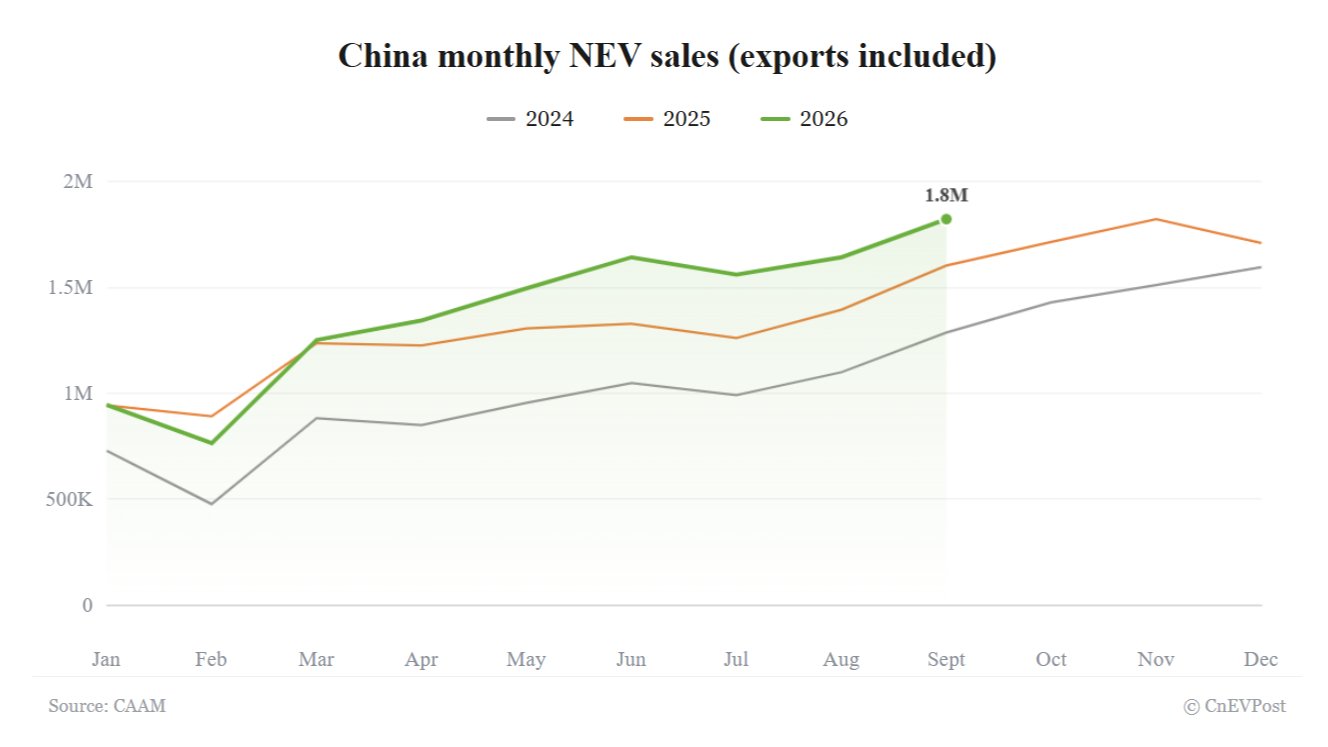
China’s new energy vehicle sector notched its strongest month of 2026 in September, but the milestone came with a twist: the growth engine has shifted almost entirely overseas. According to fresh data from the China Association of Automobile Manufacturers (CAAM), combined domestic and export NEV sales climbed to 1.823 million units last month, a 13.6 percent gain over September 2025 and an 11 percent improvement on August. That figure marks the highest monthly tally recorded so far this year, even as the year-on-year growth rate eased from the 17.8 percent pace seen a year earlier.
The headline number masks a widening split between China’s home market and its export channels. While overall NEV volumes rose, domestic deliveries actually contracted 9.4 percent year-on-year to 1.252 million units, a decline that underscores persistent softness in consumer demand at home. Offshore shipments did the heavy lifting, surging 160 percent to 571,000 units. Within that export figure, battery electric vehicles accounted for 352,000 units (up 130 percent) and plug-in hybrids contributed 219,000 units (up 220 percent). NEVs now represent roughly 54 percent of all Chinese vehicle exports, a majority for the fourth straight month.
Battery electric models remained the primary growth driver across the board. September BEV sales hit a record 1.277 million units, rising 20.7 percent year-on-year and 10 percent month-on-month. Plug-in hybrids, by contrast, were essentially flat versus a year ago at 546,000 units, though that still represented a 13.3 percent sequential gain. Combined, NEVs claimed 61.6 percent of total Chinese vehicle sales in September, up from 60.6 percent in August and the third consecutive month above the 60 percent threshold.
The domestic picture reveals how quickly conventional powertrains are losing ground inside China. Although overall domestic NEV sales slipped, their share of the domestic vehicle market rose to 65.8 percent, and their slice of the domestic passenger vehicle segment reached 68.5 percent. That shift is largely the mirror image of a collapse in fossil-fuel demand: domestic sales of conventional fuel passenger vehicles plunged 47.3 percent year-on-year to 526,000 units, a loss of 473,000 units compared with a year earlier.
Looking at the broader market, total passenger vehicle sales came in at 2.588 million units in September, down 9.5 percent year-on-year but up 8.6 percent from August. The divergence between home and abroad was stark here too, with domestic passenger vehicle sales dropping 27.4 percent while exports jumped 64.2 percent to 919,000 units. For the first nine months of 2026, NEV sales totaled 12.47 million units, up 11.1 percent and representing 53.6 percent of all vehicles sold. Passenger vehicle exports over the same period climbed 70.6 percent to 7.167 million units, while the domestic NEV tally for January through September slid 10.6 percent to 8.466 million units. CAAM described the year’s first three quarters as a period of weak domestic demand set against booming overseas sales, with no meaningful domestic recovery yet in sight.
What do you think?