
China's Electrification Story Is Really Four Separate Transitions
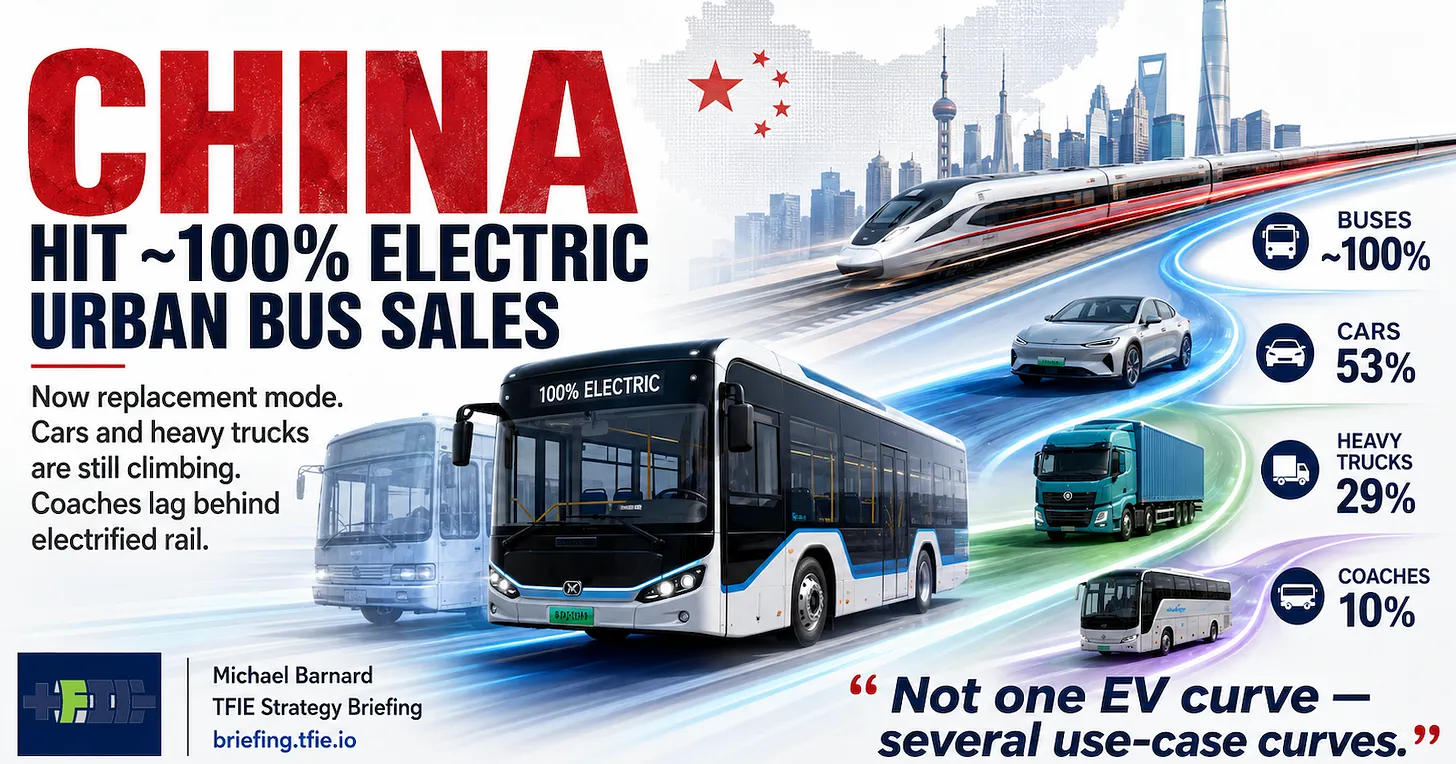
Anyone tracking China’s shift to electric vehicles through a single national market-share figure is missing most of the picture. The country’s transport electrification is not one curve climbing steadily upward — it is four distinct markets, each at a different stage of maturity.
Urban buses offer the clearest example. In city fleets, the question has shifted. Procurement officers are no longer deciding whether to swap a diesel bus for a battery-electric one; they are choosing which new electric model should take over from the electric buses bought during the country’s first big push.
According to International Energy Agency figures, close to 70% of China’s fleet of more than 680,000 electric buses was already on the road before 2020. That means a large slice of today’s bus market is renewal, not first-time conversion. Beijing’s 2025 equipment-upgrade programme backed exactly that kind of replacement — including full traction-battery swaps — and the scheme rolled into 2026. Policy still has a role, but a narrower one: it now greases the wheels of renewal in a segment where electric drive is simply the default.
Cars: From Niche to Normal
Passenger cars sit at a different point on the curve. Battery-electric models made up slightly more than half of new-car sales in China during 2025, and buyers could choose from nearly 700 electric nameplates by year’s end. The IEA reckons almost 70% of those BEVs were already cheaper than comparable combustion cars before any incentives kicked in. Electric is no longer the specialist option in Chinese showrooms. For plenty of buyers, it is just one of the sensible choices.
Heavy trucks tell another story. Their absolute share is smaller than cars, but the pace is quicker — electric trucks accounted for roughly 29% of Chinese sales in 2025, about double the 2024 level.
The strongest uptake is concentrated where it makes commercial sense: ports, mines, steelworks and industrial logistics. Those operations run predictable routes at high utilisation, and charging or battery-swapping can be built around the work schedule. A parked private car saves fuel slowly; a hard-worked truck racks up kilometres fast enough that lower energy and maintenance bills bite into the business case almost immediately.
Coaches, Rail and the Denominator Problem
Intercity coaches complicate the neat story. Battery-electric coaches were only about 10% of Chinese coach sales in 2025, even though volumes grew sharply year on year. On paper, that looks like a laggard next to city buses.
The real explanation is not battery size. Coaches compete with a technology China scaled far earlier than most nations: high-speed rail. The country closed 2025 with over 50,000 kilometres of high-speed line, carrying more than 4.5 billion passenger journeys during the year. Almost every Chinese city with more than half a million residents is on the network, which covers many 500-kilometre clusters in one to two hours and some 1,000-kilometre corridors in roughly four.
So a battery coach only needs to win the road trips that still make sense by road. Much long-distance mobility has already migrated to an electrified mode that performs better on busy intercity corridors.
This is why a single national EV percentage tends to obscure more than it reveals. Buses, cars, trucks and coaches all have wheels and batteries, yet they work different hours, return to different depots, haul different loads and face different rivals.
One caveat is worth keeping in mind. Chinese data has historically leaned on overlapping labels such as “new energy bus,” and successive IEA editions have revised classifications as better numbers surfaced. The exact shape of the early bus curve is less certain than the broad pattern: urban buses moved first and are now saturated, cars are mainstream, heavy trucks are climbing fast, coaches remain far behind.
For governments outside China, the lesson is practical. A low national EV share does not mean every segment will crawl upward at the same speed. Some categories can leap once vehicles, running costs and infrastructure line up; others may stay modest because another mode already does the job. That argues for targeting public money at uses where electrification already fits — bus fleets, depot-based operations, high-utilisation trucks — rather than trying to push an entire transport sector forward in lockstep.
Source: CleanTechnica
What do you think?