
Chevy Silverado EV: Skip the Trail Boss, Take the Trim That Packs a Spare
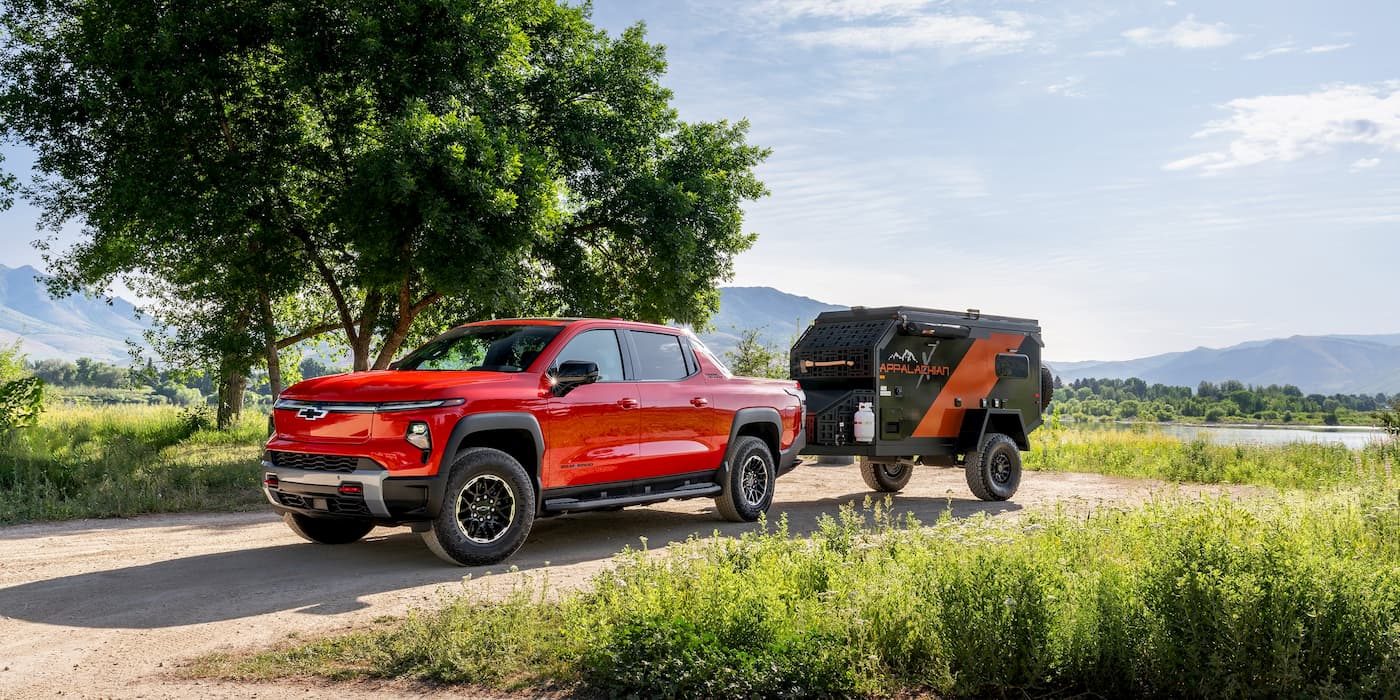
Here’s a strange irony for anyone fed up with Silverado drivetrain repairs. The electric Silverado eliminates the transmission and V8 entirely — yet the priciest, most off-road-flavored version is the one GM ships without a spare tire.
Per GM Authority’s 2027 equipment breakdown, the Silverado EV WT and LT include a spare wheel and tire, while the Trail Boss makes do with an inflator kit. The 2026 Trail Boss tester I drove had exactly that — a compressor and a bottle of sealant, no fifth wheel anywhere.
The workaround isn’t cheap, either. At launch, the only factory path to a spare carrier on the Trail Boss was a bed cover and bedslide package listed at $8,895. That’s more than I paid for my first three vehicles combined, and every one of them carried a spare.
The Money and Range Math
Strip away the two-inch lift, the all-terrain rubber and the rugged cosmetic kit, and the WT and LT look like the smarter buy on paper. Ride height and knobby tires are the Trail Boss’s main selling points. What you gain instead is a real spare and a smaller invoice.
Silverado EV at a Glance: WT Max from $76,295 · 493 mi GM-estimated range · LT Extended Range from $71,195 · 410 mi · Trail Boss from $72,095 (Extended) or $88,695 (Max) · 478 mi Max · fully optioned Trail Boss tester: $93,185
Look closely at those numbers. The WT Max travels 493 miles on GM’s estimate — 15 miles farther than the Trail Boss Max — for $12,400 less. That’s a rare case where the cheaper truck also goes the distance.
Why Gas Owners Are Peeking at the EV
Spend any time in the Silverado owner forums and the pattern jumps out: drivetrain complaints dominate. One 2022 Z71 reportedly lost its 10-speed at 33,000 miles with a line of similar trucks ahead of it at the dealership. Another owner’s 2019 unit lasted 130,000 miles; his coworker’s gave up at 87,000.
Engine trouble gets its own chapter. NHTSA opened an engineering analysis in August 2026 covering 997,743 GM trucks and SUVs with the 6.2-liter L87 V8, after roughly 499 complaints of failures following recall repairs. Some owners who passed inspection received thicker 0W-40 oil rather than a new engine — and at certain dealers, only a fresh oil cap.
When a 6.2 does let go, the fix can take months. One Trail Boss owner’s V8 died at 98,876 miles; the replacement engine was backordered with no delivery date.
What the EV Sidesteps
Every Silverado EV, regardless of trim, uses a single-speed reduction gear in place of a conventional gearbox. No torque converter. No valve body. No transmission fluid to change, ever.
That’s a meaningful difference for anyone who has been quoted $1,400 for a 45,000-mile transmission service — and found most independent shops unwilling to touch the job. It’s also the reason a Trail Boss fan who lost a 10-speed at 33,000 miles might start doing the arithmetic differently.
The Catch With an Inflator Kit
Sealant can plug a nail hole in the tread. It cannot rescue a sidewall sliced open on rock, and it won’t help if the puncture sits too close to the shoulder to patch. Blow a tire while towing a camper and you’re calling a flatbed.
Heavy, high-torque trucks also chew through rubber faster, which raises the odds of picking up a puncture in the first place. Ford fits a full-size spare beneath the F-150 Lightning, and Rivian sells one for the R2 at $775. GM’s decision to leave it off the trail-oriented trim stands out.
If you insist on the Trail Boss, budget for a matching wheel and tire, a tested jack, and somewhere to strap it all down. Aftermarket compact-spare kits exist — Modern Spare built one for the Mustang Mach-E — but you’re the one paying for it.
Behind the Wheel
The powertrain was the highlight of my time with the truck. The Max Range Trail Boss delivers 725 horsepower and 775 pound-feet, and it does so in near silence, with no shift shock at any speed.
Weight is the trade-off. At roughly 9,000 pounds, the truck feels every ounce of it. A 6,000-pound Suburban I drove the week before felt considerably more agile. Visibility doesn’t help either — the window openings reminded me of a building’s basement slits.
Then there’s the infotainment. No Apple CarPlay or Android Auto on any Silverado EV, and a GM spokesperson confirmed the CarPlay integration coming to the 2027 Silverado and Sierra applies to the gas trucks only. The 17.7-inch screen with Google built in works, but I still found myself holding my phone at stoplights.
Charging Costs, Real World
My tester used a CCS port, so instead of an adapter at a Tesla Supercharger I spent an hour on an Autel DC unit outside a town hall. At 50 cents per kWh, filling the 205 kWh pack ran about $102 — roughly 21 cents per mile over 478 miles in mild fall weather. Winter in New England would push that closer to 26 cents.
Plug in at home and the picture changes fast. At 15 cents per kWh, the same fill costs about $31, or 6 cents per mile. A gas Silverado averaging 17 mpg on $3 fuel runs around 18 cents per mile.
The Verdict
If transmission shudder and lifter failures are what pushed you toward an electric Silverado, the logic holds up — there’s simply no gearbox or V8 left to break. Just don’t assume the off-road trim is the one to have.
- Want the spare? WT or LT.
- Want maximum range? WT Max, at 493 miles.
- Want the lowest price? LT Extended Range, from $71,195.
- Want the Trail Boss look? Budget extra for a wheel, tire and mounting solution.
The cheaper trucks win on range, price and equipment. That’s not the answer most shoppers expect.
Source: Torque News
Curious how this compares to other EVs? Try our comparison tool →What do you think?