
BYD Rolls Out Its 150,000th Commercial EV, an 800-Horsepower Q3 Electric Semi
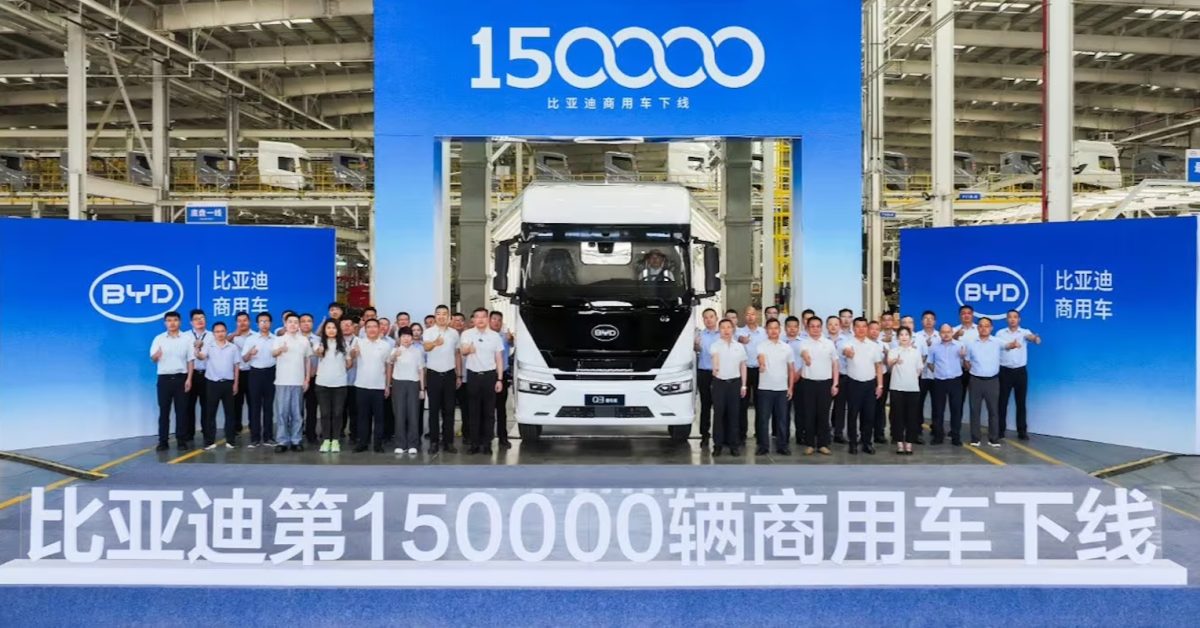
BYD has hit a production milestone that underlines just how far its commercial vehicle division has come. This week, the company’s truck plant in Huai’an, Jiangsu province, sent its 150,000th new energy commercial vehicle down the line — a Q3 battery-electric semi truck packing roughly 800 horsepower.
The Q3 is no small hauler. It pairs 600 kWh of BYD’s familiar blade-style lithium iron phosphate (LFP) battery packs with a 600 kW dual-motor setup, a combination the automaker says can move 108,000 pounds of gross combined vehicle weight about 200 miles (325 km) on a single charge. To keep fleets moving, BYD has built in dual-gun DC fast charging support, which it claims can take the truck from a 20% to 80% state of charge in half an hour.
While BYD built its reputation on passenger cars and batteries, heavy trucks have become an increasingly important part of the picture. Battery-electric semis give fleet operators a path to sharply reduce diesel consumption and emissions without giving up the capability needed to haul heavy loads over long distances. Reaching the 150,000-unit mark shows that segment is turning into a serious business in its own right.
The numbers behind the milestone are notable. BYD sold 6,848 NEV trucks in September alone, a 113.33% jump year-over-year. Through the first nine months of 2026, the company delivered 53,032 units, up 28.46% compared with the same period in 2025. That kind of growth suggests commercial electrification is moving from pilot programs toward mainstream fleet adoption.
BYD’s commercial ambitions have been building for a while. The company has repeatedly expanded its electric truck lineup and supporting infrastructure, including work on higher-capacity charging for its flagship long-range offerings. With the Q3 now emblematic of its 150,000th commercial NEV, BYD is signaling that the same momentum it built in passenger EVs is being directed squarely at the heavy-duty segment.
What do you think?