
Brunton H-3: The American-Made Military Compass Still Built Like a Tool, Not a Gadget
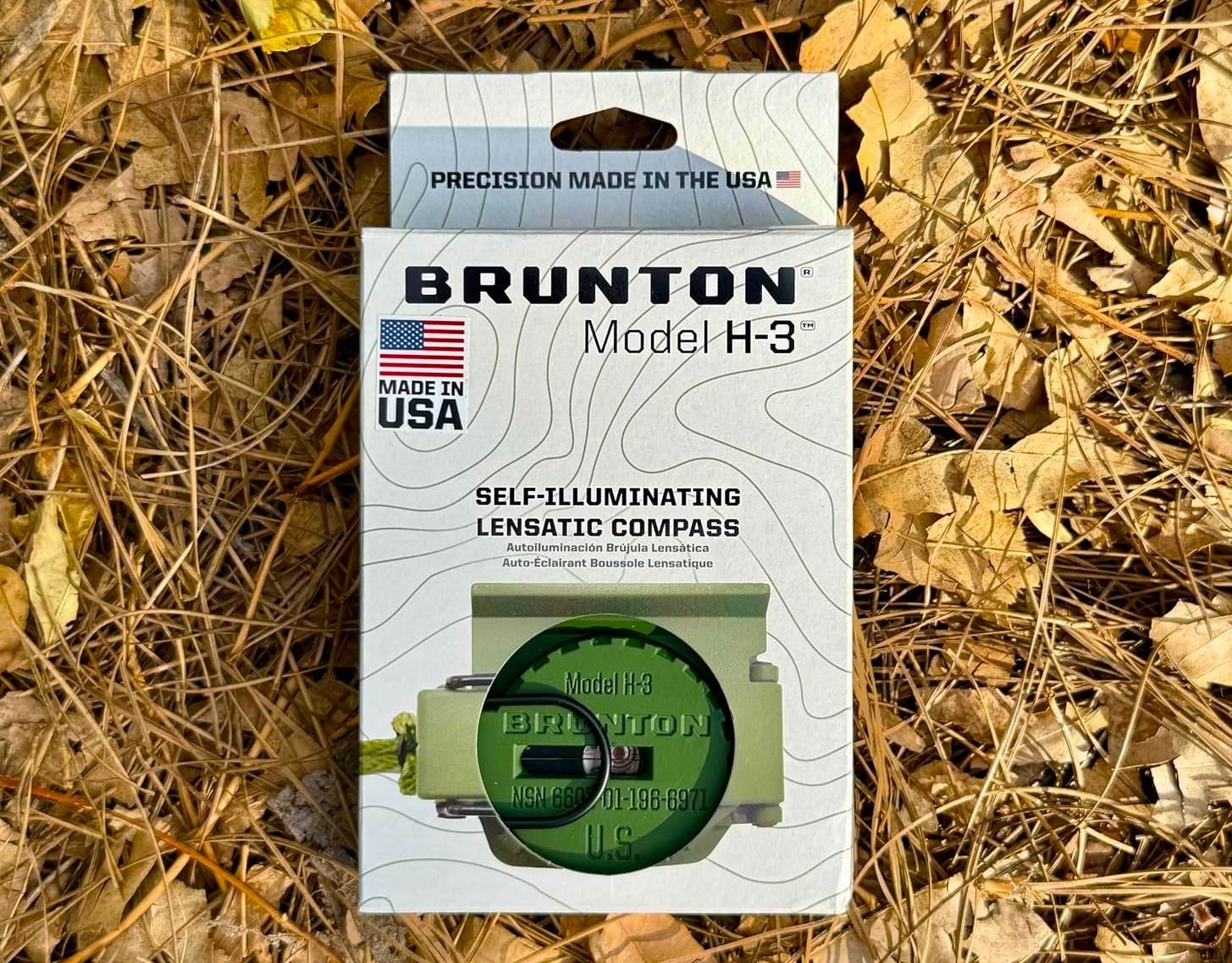
Some field gear earns its keep by surviving conditions that would destroy everything else in your pack. The Brunton H-3 Military Lensatic Compass is a member of that club — and it’s still assembled in Riverton, Wyoming, not outsourced to a factory somewhere far from the terrain it was designed for.
The H-3 is a lensatic compass built to military spec, and Brunton says it clears US military requirements rather than merely scraping past them. It also meets Buy America Act standards, a detail that matters to buyers who care where their instruments come from.
What’s Actually Inside
The needle is a rare-earth magnet riding on a sapphire bearing. It settles in roughly three seconds — about 30% quicker than competing units, according to Brunton. The vial is dry and induction-damped, which means there’s no fluid to leak out in the cold or freeze solid on a winter ascent.
The dial carries two scales: 0 to 6,400 mils on the outer ring and 0 to 360 degrees inside. You can flip between them. Brunton sells separate Northern and Southern Hemisphere versions, so the needle is balanced for wherever you actually use it.
For low-light work, seven sealed tritium vials keep glowing for 12 years or more — no batteries, no charging cable. The housing is powder-coated die-cast aluminum, rated waterproof, dustproof, shockproof and sandproof. A scratch-resistant glass lens sits up front, and the bezel is built to hold its click instead of going sloppy after a season of use. Total weight lands at 5.76 oz (163 grams).
It ships with a pouch that mounts to a belt, an Alice clip or Molle webbing, plus a cord for wearing it around the neck.
A Company That Kept Coming Home
Brunton’s story starts in 1894, when Colorado mining engineer David W. Brunton patented the Pocket Transit. The instrument combined magnetic compass readings with clinometer functions in one handheld case, which made it a hit with geologists and surveyors almost immediately. Production scaled up through a partnership with William Ainsworth in Denver, and the US military later adopted a modified version known as the M2.
Ownership changed hands several times over the following decades. Swedish compass maker Silva bought Brunton in 1996, then Finnish conglomerate Fiskars held it, and later the Swedish outdoor group Fenix Outdoor — also the parent of Fjällräven — took over. Under those European owners, the catalog widened to binoculars, headlamps and portable power gear.
In 2021 the brand came back to American hands. Geologist Lauren Heerschap and her husband David bought the company and steered it toward core instruments and continued US manufacturing. That’s the footing the 131-year-old firm stands on today.
The H-3 is available through Brunton’s official Amazon store. Professionals in geology, mining, surveying, forestry, search and rescue, and archaeological fieldwork have long treated Brunton compasses as the default choice — the kind of tool that gets handed down rather than replaced.
Source: Silodrome
What do you think?