
A True Business Coupe: 1950 Plymouth Hits the Market
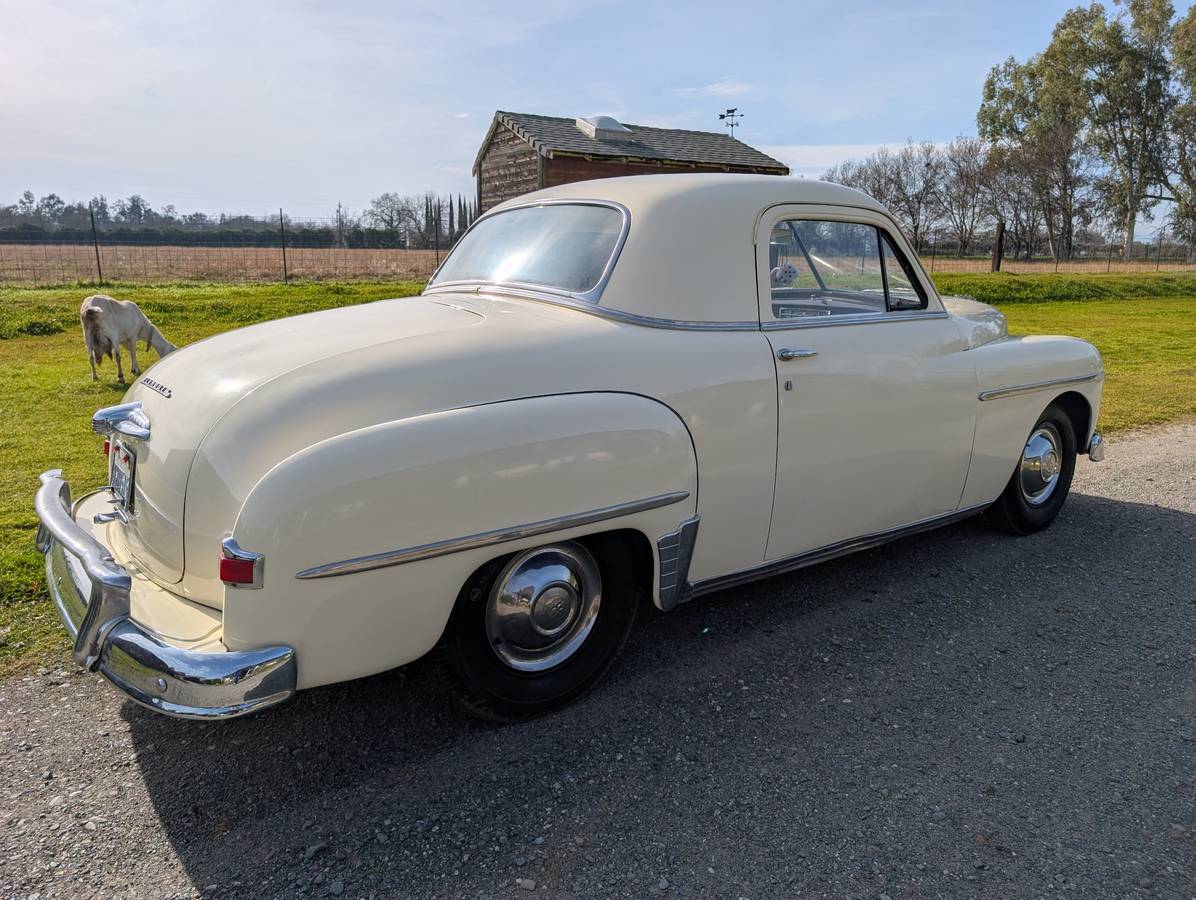
Business coupes are a favorite among old-car enthusiasts, and genuine ones are harder to find than most sellers admit. Plenty of listings promise a business coupe only to deliver a club coupe or, worse, a sedan with a trunk. This 1950 Plymouth, offered on craigslist out of Gerber, California for $13,000, is the authentic article: two seats, a generously sized trunk and a deliberately sparse window count. According to period research, the body style rode a 111-inch wheelbase and came in two trims, De Luxe and Special De Luxe, with the higher level adding a horn ring, stainless windshield trim and similar touches.
The postwar years were unforgiving for automakers. A company either had fresh designs ready once production resumed, or it fell behind. A few seasons later, the same question applied to V8 power. Plymouth, Chrysler’s volume division, largely sat out both waves. Styling changed slowly, and some 1949 models were essentially 1948 cars that received a new model-year label partway through the run, a trick made possible by slow-moving inventory. Under the hood sits Chrysler’s 217-cubic-inch flathead six, an engine family dating to the 1930s when it displaced less. In 1950 form it produced 97 horsepower, routed through the only gearbox on offer: a three-speed column-shifted manual. The radiator and tires are fresh, and the car retains its original 6-volt electrical system, though several lengths of non-original wiring are visible in the engine bay. The seller reports it runs well.
Inside, the cabin feels more like a small parlor than a car, with upright, chair-like seats and a faux-wood painted dashboard. There is room to improve: the steering wheel would benefit from reconditioning, the chrome needs polishing and the rearview mirror wants fresh silvering. The upholstery and headliner, by contrast, are described as being in very good shape.
Outside, the front grille surround carries a dent and the hood gap is tight along the driver’s side, but the paint presents nicely. On pricing, the market is sending a clear signal that late-’40s and early-’50s Plymouth enthusiasts are thinning out. An occasional hot rod build can clear $20,000, while sedans and coupes generally settle in the mid- to high four-figure range. That makes the seller’s ask a figure worth weighing against the car’s condition and the shrinking pool of buyers for this era of Plymouth.
What do you think?