
A Derelict 1951 Frazer Manhattan Emerges From a Wisconsin Farm
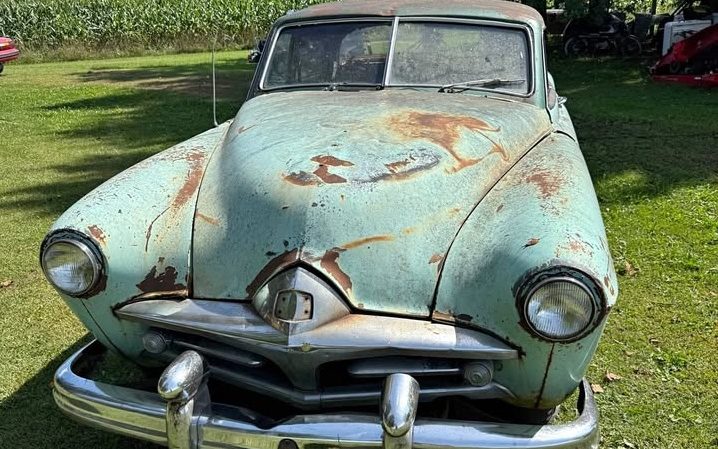
A weathered 1951 Frazer Manhattan has surfaced on Facebook Marketplace, sitting abandoned east of Wausau, Wisconsin, and its seller is asking just $1,000 or best offer. The vendor admits knowing little about the car, noting only that a previous owner “had it running and moving on spray” — likely a shot of fuel or starter fluid into the carburetor. The listing bundles in a spare seized engine, fresh rocker panels (badly needed), and assorted odds and ends. Any original title is long gone.
The condition is grim. Daylight shows through the driver-side floorboards, the rockers have essentially vanished, and the tires are flat. Yet not everything is lost: several body panels hold up reasonably well, the front and rear chrome — parts that would be near-impossible to source today — looks salvageable, the glass survives, and one hubcap remains.
Frazer’s story is a tangled one. The sedan was styled by Howard “Dutch” Darrin, celebrated for his custom Packards built for Hollywood stars, and it earned a design award. The Frazer nameplate debuted in June 1946 as a four-door sedan at a moment when genuinely new postwar designs were scarce, and its body shell shared much with the slightly cheaper Kaiser. For 1951, power came from a 115-horsepower Continental Red Seal “Supersonic” L-head six displacing 226 cubic inches. The Manhattan Series F47C served as the luxury trim, launched in 1947 at roughly $500 above a standard Frazer F-47. Even at its peak, Frazer captured only about 1.5 percent of the U.S. market in 1948.
Buyers in 1951 could choose among a four-door convertible, a hardtop sedan, and the Vagabond with its early hatchback layout — this example appears to be the hardtop. It was the marque’s final year; afterward, everything carried the Kaiser badge. The public warmed to the ‘51 models, with some 50,000 orders placed, but Joseph W. Frazer had already departed the company and the reprieve came too late to matter.
Realistically, reviving this car means new fuel lines, a replacement gas tank, and ultimately an expensive rotisserie frame-off restoration followed by a full interior rebuild — the seat frames are about all that remain inside. A rough estimate puts proper rehabilitation near $40,000, while a fully restored Manhattan convertible recently changed hands for $33,600. That restored drop-top is worth far more than this ordinary sedan, which pushes the Wisconsin car firmly back into parts-donor territory, valued mainly as a source of spares for a more desirable project.
What do you think?