
- Explain what homologation/type approval is and why it exists.
- List the main regional regulatory frameworks at a conceptual level (UNECE, EU, FMVSS, GB).
- Summarize EV-specific regulation areas (battery safety, electrical safety, EMC, crash, AVAS).
- Explain why regulatory fragmentation across regions affects vehicle design and program cost.
- State why this lesson deliberately avoids citing specific current regulation numbers or dates.
EV-36 — Homologation / Regulations
ASSUMPTION — Regulatory numbers, dates, and specific clause references change over time and differ by market, and this lesson deliberately does not cite any as current or authoritative. It introduces the structure of vehicle regulation — why it exists, how regions differ in approach, and which areas matter specifically for EVs. Always verify the current, region-specific regulation before relying on any number for engineering or compliance work.
1. Why Vehicles Need Formal Approval Before Sale
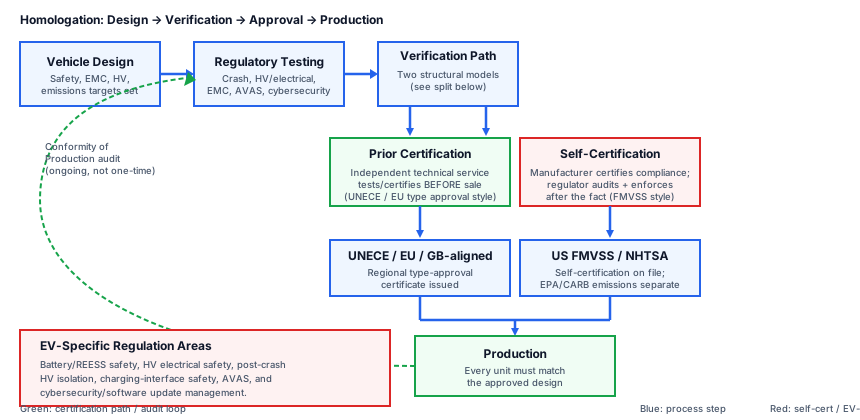
A vehicle is a mass-produced product that will be operated by the general public, often at speed, in close proximity to pedestrians and other vehicles, and it carries systems — brakes, steering, and in an EV’s case a high-voltage energy source — whose failure can cause serious harm. Letting each manufacturer decide independently what counts as “safe enough” would mean the public bears the risk of that judgment without ever having agreed to it. Homologation, also called type approval, is the regulatory answer to this: an independent authority (or, in some markets, the manufacturer under a self-certification model) confirms, before a vehicle type reaches the public, that it meets a defined set of safety, environmental, and — increasingly — cybersecurity requirements. Passing homologation is not a one-time formality; production vehicles must continue to conform to the approved type throughout the production run, which is why manufacturers maintain conformity-of-production processes rather than testing only a handful of prototypes.
FACT — Type approval addresses two different questions that are easy to conflate: whether the vehicle design meets the requirements (design verification), and whether every produced unit still matches that approved design (conformity of production). Both must hold for approval to remain valid.
2. Two Broad Regulatory Philosophies
Although the details vary by country and change over time, most of the world’s vehicle regulation falls into one of two broad structural approaches, and understanding the difference matters more for engineering purposes than memorizing any specific rule number. Under a type-approval model (used across much of Europe and many markets that reference UNECE regulations), an independent, government-designated technical service tests and certifies the vehicle before it may be sold, and the manufacturer cannot legally sell the vehicle without that prior certificate. Under a self-certification model (historically the U.S. approach under FMVSS), the manufacturer itself certifies that the vehicle meets the applicable federal standards, and the regulator’s role is primarily to audit compliance and enforce corrective action (including recalls) after the fact if a vehicle turns out not to conform. Neither approach is inherently “stricter” than the other — they simply place the verification burden at different points in the process — but they do mean a manufacturer selling into both types of market needs two structurally different compliance programs, not just one program translated into two languages.
INTERPRETATION — This split between prior-certification and self-certification-with-after-the-fact-enforcement is one of the more consequential structural differences a global vehicle program has to design around, independent of any specific numbered regulation.
3. Regional Frameworks at a Conceptual Level
Rather than listing specific regulation numbers (which change and must always be re-verified against current, official sources before engineering use), it is more durable to understand the role each major framework plays:
| Region / body | Conceptual role |
|---|---|
| UNECE (United Nations) | A harmonized set of vehicle regulations that many countries reference or adopt directly, covering areas from crash safety to electrical safety to cybersecurity and software update management |
| European Union | Builds its own type-approval regime largely on top of UNECE-style regulations, with EU-specific administrative requirements |
| United States (FMVSS / NHTSA, plus EPA and CARB for emissions/environmental rules) | A self-certification model with federal safety standards and separate environmental/emissions regulation |
| China (GB standards) | A national standards system with its own type-approval process, including EV-specific battery and safety standards |
| Other national frameworks (including Türkiye’s) | Often reference or align closely with UNECE-style regulations while adding national administrative requirements |
ASSUMPTION — This table describes structural roles, not current legal text. Every real compliance program must consult the current, officially published regulation for the specific market and vehicle category involved.
4. Why EV-Specific Regulation Areas Exist
Internal-combustion vehicle regulation already covers crash safety, braking, steering, and emissions, but an EV introduces hazard categories that simply did not exist in the same form before, which is why dedicated EV-specific regulatory areas have grown alongside the technology:
- Battery / REESS (Rechargeable Energy Storage System) safety — addresses thermal runaway propagation, mechanical abuse (crush, penetration), and short-circuit protection, none of which have a direct ICE-fuel-tank equivalent in scope or failure mode.
- Electrical safety / HV protection — addresses electric-shock protection for occupants, rescue personnel, and service technicians, both in normal operation and after a crash.
- EMC (electromagnetic compatibility) — is more demanding in an EV because power electronics switch large currents at high frequency, which can radiate interference that must not disrupt the vehicle’s own safety-critical electronics or those of nearby vehicles.
- Crash and post-crash safety — extends beyond structural crashworthiness to include HV disconnection behavior and isolation integrity after an impact, so that rescue personnel are not exposed to residual HV risk.
- Charging interface safety — covers the vehicle-charger connection itself, since it is a user-accessible high-power interface used far more frequently than, say, a fuel-tank filler cap.
- Pedestrian safety / AVAS (Acoustic Vehicle Alerting System) — addresses the fact that an EV can be nearly silent at low speed, which removed a cue pedestrians and cyclists had relied on with combustion vehicles.
- Cybersecurity and software update management — increasingly formalized as part of vehicle approval, reflecting the EV/software-defined vehicle’s much larger connected attack surface (EV-35).
5. Regulatory Fragmentation as an Engineering Constraint
Because these frameworks are not identical across regions, a vehicle program selling into multiple markets faces genuine engineering trade-offs, not merely paperwork. A battery pack architecture, an AVAS sound profile, or an HV isolation threshold that satisfies one region’s requirements is not guaranteed to satisfy another’s, so global programs commonly either design to the most stringent applicable requirement across all target markets (accepting some over-engineering in less strict markets) or maintain region-specific variants (accepting added complexity and cost in the supply chain and validation program). Neither choice is free, which is one reason regulatory strategy is decided early in a vehicle program, not bolted on near launch.
6. FAQ
Which regulations matter most for EV homologation?
ASSUMPTION — The specific set depends on the target market and vehicle category and must be verified against current, official sources; conceptually, electrical/battery safety, crash and post-crash HV behavior, EMC, and increasingly cybersecurity are the areas that differ most from a purely ICE-focused regulatory baseline.
Why do regulations differ so much by market?
FACT — Different regions developed their vehicle-safety regulatory systems independently, under different legal traditions (prior certification vs. self-certification) and different institutional structures, so full harmonization has been a gradual, ongoing process rather than a starting condition.
Does passing UNECE-style approval automatically satisfy FMVSS, or vice versa?
FACT — No — the two are separate regulatory systems with different structures and requirements; a vehicle intended for both markets must generally be verified against each one independently, even where individual technical requirements happen to be similar.
7. Summary
- Homologation (type approval) confirms a vehicle design — and every unit produced from it — meets defined safety/environmental/cybersecurity requirements before or alongside sale.
- Regulatory systems broadly fall into prior-certification (e.g., UNECE-referencing markets) and self-certification-with-enforcement (e.g., historically the US FMVSS approach) models, which is a more durable distinction than any specific rule number.
- UNECE, EU, US (FMVSS/EPA/CARB), China (GB), and other national frameworks each play a structurally distinct role, and their specific requirements must always be verified against current official sources.
- EV-specific regulation areas — battery/REESS safety, HV electrical safety, EMC, post-crash HV behavior, charging-interface safety, AVAS, and cybersecurity — exist because EVs introduce hazard categories with no direct ICE equivalent.
- Regulatory fragmentation across regions is a real engineering constraint that shapes vehicle architecture decisions, not just an administrative afterthought.
8. Sources and Verification Note
This lesson deliberately avoids citing specific regulation numbers, clauses, or dates as current, since these change and must be verified against official, up-to-date sources before any engineering or compliance use.
- UNECE — general regulatory framework structure (verify current regulation numbers before use).
- FMVSS — general self-certification framework structure (verify current standard numbers before use).
ASSUMPTION — Every specific regulation reference must be re-verified against the current, official text before any engineering or compliance decision.
Next Lesson
- EV-37 — Charging Standards: CCS, CHAdeMO, NACS, and ISO 15118.
Technical Diagrams
Quiz
What is type approval?
Type approval confirms a vehicle meets applicable safety/environmental regulations.
What does UNECE R100 cover?
R100 covers electric-shock and battery safety requirements for EVs.
Which framework sets US vehicle safety standards?
In the US, FMVSS/NHTSA sets vehicle safety standards.
Which standards are used in China?
China uses GB standards.
What is one EV-specific regulation area?
Battery safety (REESS) is an EV-specific regulation area.
Why is last_verified mandatory in regulation records?
Because regulations change, last_verified is mandatory for freshness tracking.