
TotalEnergies' Passive CKP Plate Keeps Immersion Fluid Where It Matters During a Battery Vent
Immersion cooling has become one of the more convincing answers to the heat problem in high-performance lithium-ion packs. TotalEnergies Lubrifiants now says the concept needs a small piece of mechanical help to stay safe after something goes wrong inside a cell — and it has built that help without adding a single sensor.
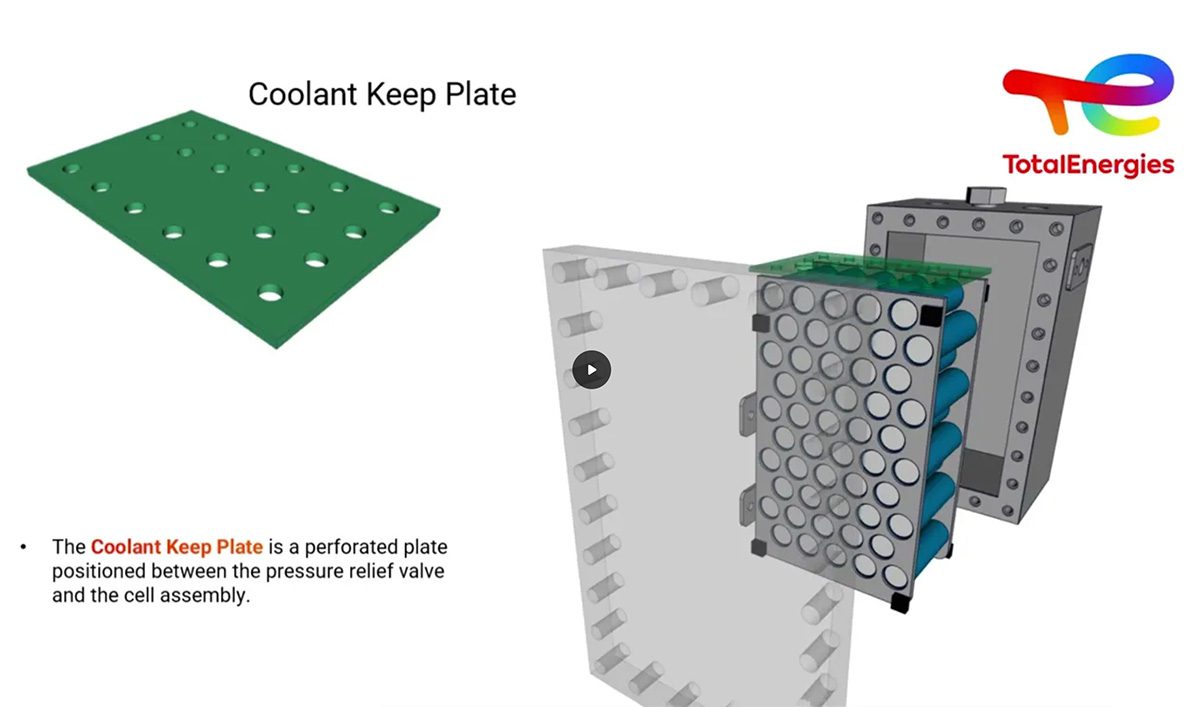
The company’s Coolant Keep Plate, or CKP, is a passive part that sits inside an immersion-cooled pack and keeps the dielectric fluid in place when a cell vents hot gas.
Why immersion alone falls short
Dropping cells directly into a dielectric bath removes layers of thermal interface material between the cell and the cooling circuit. Heat moves faster, temperatures even out across the pack, and the odds of a fire or a chain reaction drop.
The weak point shows up during a venting event. A jet of gas can shove fluid away from the cells closest to the failure, and those cells are suddenly without cooling. Propagation can then restart from a spot that was supposed to be protected.
“Immersion alone is not sufficient. To preserve thermal protection after the first venting event, the fluid must remain around the initiating cell and the cells that have received the highest thermal load.” — Gérard Quoirin, Battery Specialist at TotalEnergies Lubrifiants
A plate that separates gas from liquid
The CKP is mounted in the path between the cells and the venting opening. Its job is simple in principle: let the gas out, keep the liquid in.
Because the part relies on geometry rather than electronics, it needs no power feed, no control unit and no sensing hardware. That matters for pack designers who are already fighting for every gram and every watt.
- Passive operation: no sensors, controls or electrical supply
- Function: splits gas from liquid during venting and holds fluid around the hottest cells
- Test results: no fire or propagation seen with the plate fitted, including configurations that propagated without it
- Compatibility: tuned for TotalEnergies’ own dielectric fluids, with the principle open to other cell formats and pack layouts
TotalEnergies ran the plate across several battery configurations. In each case, adding the CKP prevented fire and stopped thermal runaway from spreading — even in setups where the same pack did propagate when the part was absent.
What it means for pack designers
The CKP was developed around TotalEnergies’ own dielectric fluid range, so it is not a drop-in part for every chemistry or every supplier’s coolant. Still, the underlying idea — a shaped barrier that manages two-phase flow at the vent — could be reworked for other immersion architectures.
Fast charging is where this gets interesting. Higher charge rates push cells harder, and immersion is often pitched as the way to keep those temperatures in check. A passive safeguard that preserves that cooling after the first cell fails makes the whole approach easier to defend in a safety review.
Don’t expect a headline spec sheet from this one. It is a component, not a product, and TotalEnergies has not announced production partners or timelines. But for engineers weighing immersion cooling against more conventional cold plates, the CKP is the kind of detail that decides whether a concept survives contact with a real pack.
Source: Charged EVs
Curious how this compares to other EVs? Try our comparison tool →What do you think?