
Sakuu Dry-Prints a Metal-Free Carbon Fiber Battery Cell on Its Kavian Platform
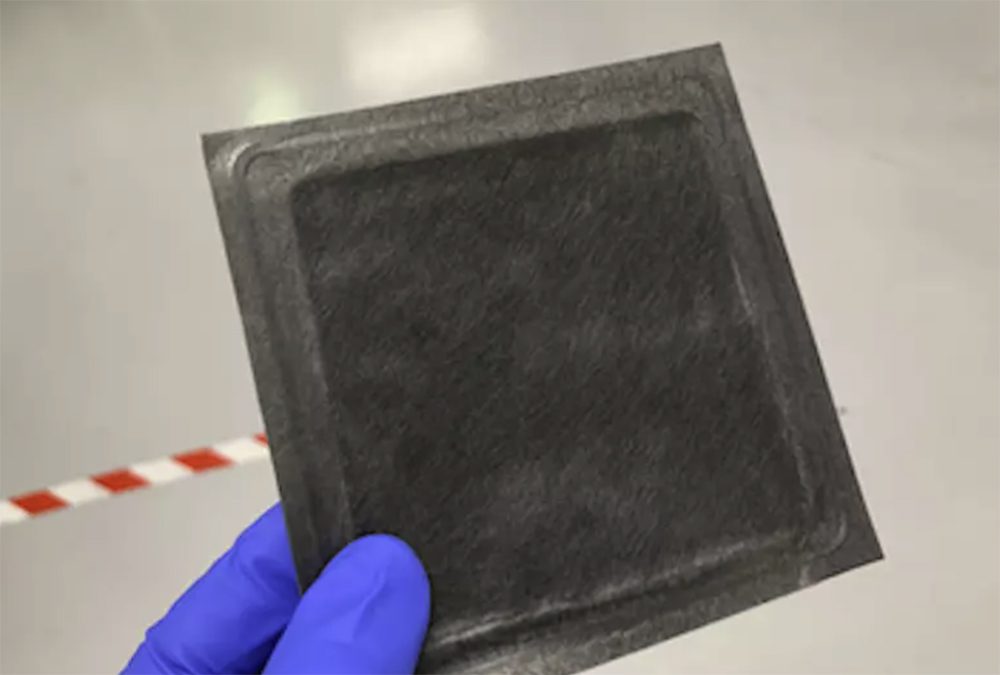
Battery manufacturing equipment specialist Sakuu says it has produced a fully working lithium-ion cell that contains no metal at all, printing both the anode and the cathode through a dry process on its Kavian manufacturing platform. The 0.5 Ah test cell pairs a carbon composite with a polymeric current collector (PCC) architecture, a design the company claims is structurally reinforced by the carbon fiber while staying bendable and very light.
The core claim is safety. According to Sakuu, a PCC cell is built as a series-connected stack rather than a parallel one. Each layer is sealed on its own and linked directly to the next, with current traveling vertically through the stack across the full contact surface. Because of that layout, the company says, a short, a flaw or a puncture anywhere in the cell bleeds energy away gradually instead of dumping heat, which it argues removes the fire risk that haunts conventional lithium-ion designs. Sakuu describes the test cell as immune to thermal runaway.
The materials story matters just as much. Sakuu says the cell relies on lightweight, low-cost inputs that are readily available worldwide. The engineering hurdle is that thin polymer films tend to wrinkle, and wrinkles interfere with reliable electrical contact. Carbon fiber does not wrinkle, and according to Sakuu CTO Karl Littau, using carbon fiber veils lets the company build electrode and current collector layers that are strong yet conformable. The fibers push through the current collector and lodge inside the dry powder anode and cathode, creating tight contact between neighboring layers plus a conductive reinforcing network.
Why hasn’t anyone sold such cells yet? Sakuu’s answer is that wet-process equipment simply cannot make them. That is where the company positions Kavian: its dry-process manufacturing line is presented as the route to volume production at acceptable cost. Arwed Niestroj, President and COO, framed the result as a break from three decades of stagnation in battery manufacturing and argued that scalable production of safer cells is what surging demand across transportation and energy storage actually requires — with the added twist that these cells could double as structural elements in future designs.
One demonstration cell is a long way from a commercial product line, and Sakuu has not published production timelines or customer commitments to accompany the announcement. Still, the test validates a specific thesis: that dropping metal foils and wet chemistry in favor of dry-printed carbon composites could yield cells that are safer, lighter and easier to integrate into load-bearing structures. For an industry chasing both energy density and fire safety, that combination is worth watching.
What do you think?