
Parker Hannifin Adds Three Thermal Adhesives to CoolTherm Lineup for EV Batteries
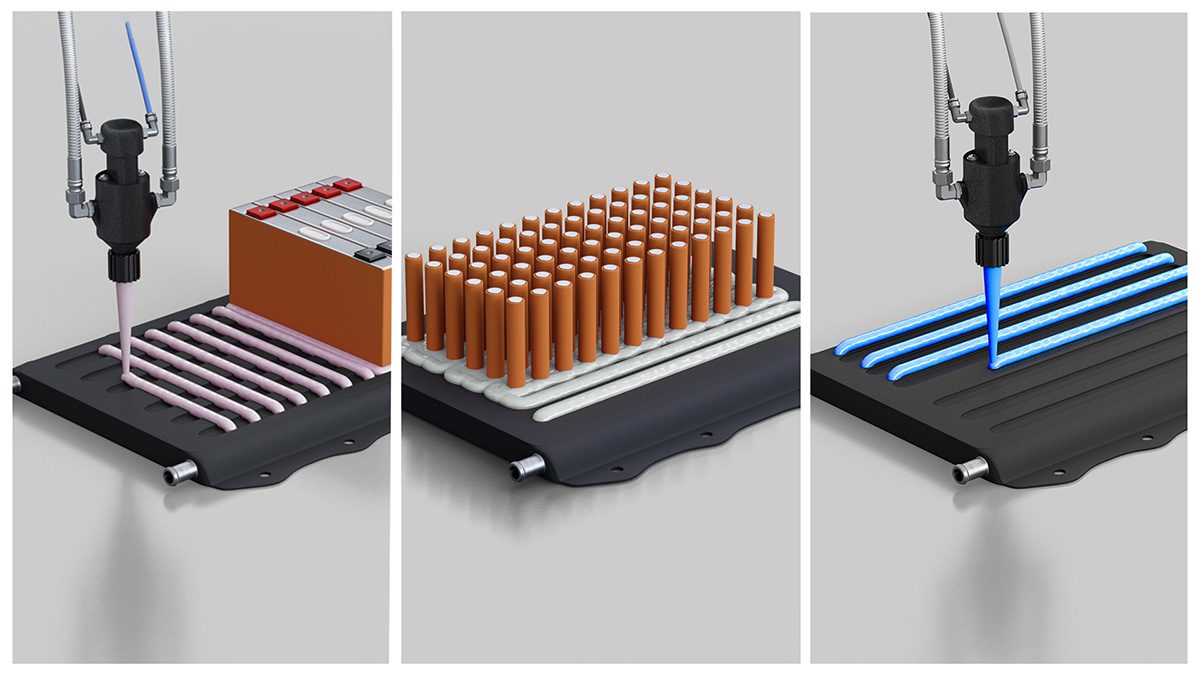
Parker Hannifin’s Performance Materials Division has broadened its CoolTherm product family with three new thermally conductive adhesives aimed at electric vehicle and industrial electrification programs, giving battery engineers more options for bonding and thermal management inside the pack.
The trio covers distinct production needs. CoolTherm UR-2800 is a urethane adhesive formulated for stronger bonds across a wider range of substrates along with a fast cure, a combination the company says supports higher-throughput assembly. CoolTherm UR-2400 SLW takes the opposite tack: it cures slowly, delivers roughly 2.0 W/m·K thermal conductivity, and pairs moderate-to-high strength with high toughness while leaving extra working time for rework. CoolTherm TC-2080 keeps the core properties of the existing TC-2002 grade but eliminates glass spacers and is built for very large dispensed beads, with improved sag resistance to hold shape during application.
The timing reflects how pack designs are shifting. As battery architectures evolve, manufacturers are pushing for adhesive solutions that are already proven in production and can improve reliability, manufacturability and design flexibility at once. Parker Lord, the company’s adhesives business, is positioning the new urethane and acrylic technologies as answers to that demand.
According to Jonathan Halbur, Senior Product Engineer in the Performance Materials Division, the products were developed in response to a growing need for robust, thermally conductive bonding solutions that can serve electrification platforms across a wide range of global applications.
Thermal adhesives sit at a critical intersection in EV assembly, holding cells, modules and cooling structures together while also helping move heat away from those components. Small changes in cure speed, bond strength or bead behavior can have an outsized effect on how quickly a pack line can run and how easily a defective unit can be reworked, which is why suppliers are keen to offer grades tailored to different manufacturing steps.
Parker’s expansion lands in a crowded and fast-moving corner of the EV supply chain, where materials specialists increasingly compete on production readiness rather than lab performance alone. For now, the company is leaning on the breadth of the CoolTherm range — spanning fast-cure, rework-friendly and large-bead formulations — as its pitch to electrification programs worldwide.
What do you think?