
Ford's Fathom Bet: 146 Parts Become 2 as America's Cheapest EV Pickup Takes Shape
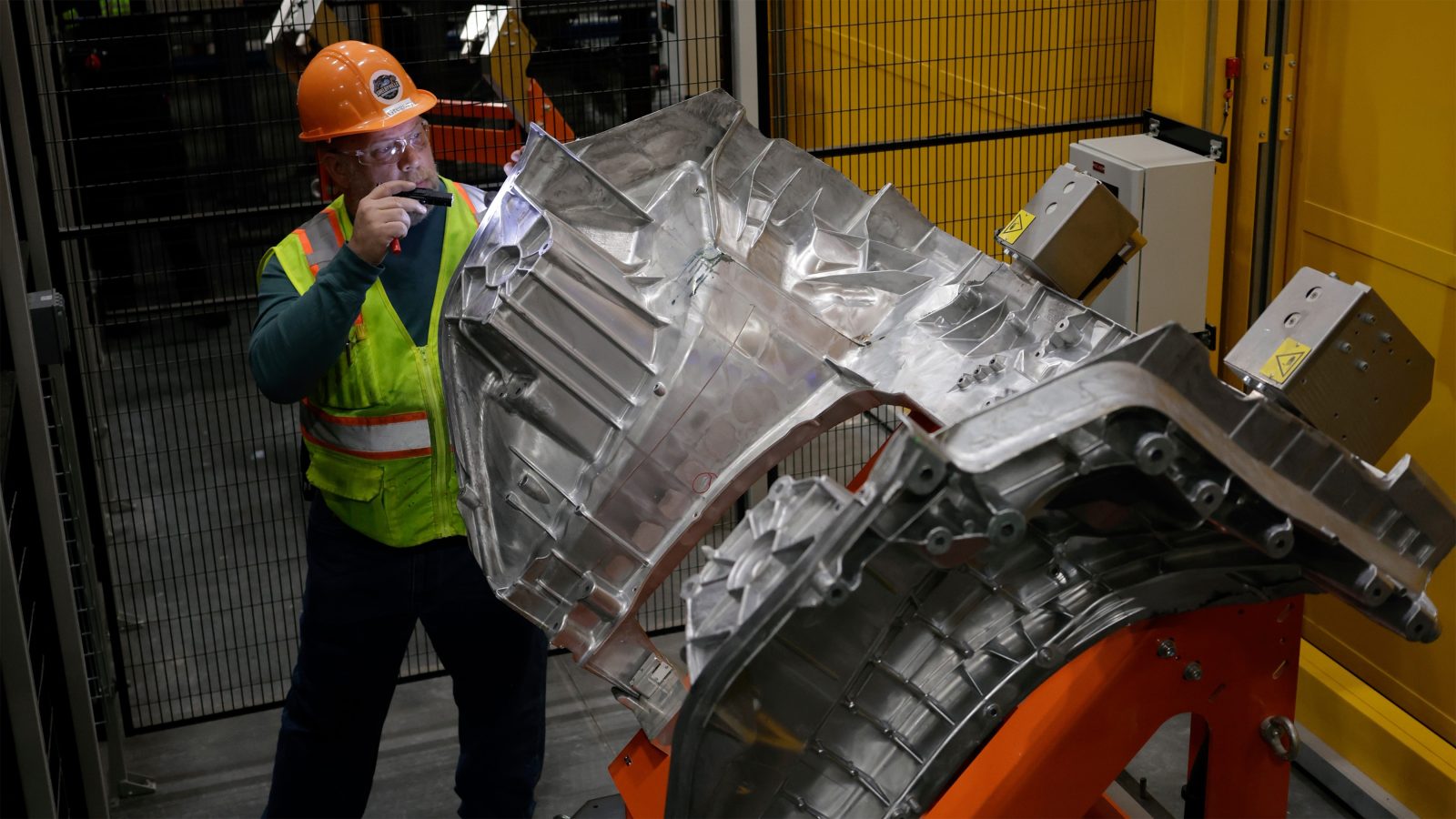
Ford has pushed more than 5,000 aluminum “unicastings” through its casting lines for the Fathom, the midsize electric pickup it plans to sell from $28,350 starting in 2027. Each truck will use exactly two of them — one up front, one at the back — replacing a combined 146 individual components.
The milestone, disclosed by Ford advanced vehicle structure chief engineer Vladimir Bogachuk on the company’s From the Road blog, is the strongest signal yet that the Blue Oval has embraced the megacasting playbook Tesla made famous.
Where the parts are made
Aluminum ingots are melted at roughly 1,300°F (700°C) at Ford’s Shelbyville Technical Center, then injected into front or rear structure molds. A robot lifts the finished piece, dunks it in a quench tank, and the part is trimmed and machined.
Then comes the vetting. Ford X-rays every batch for internal pores and voids, measures dimensions in a climate-controlled room, runs optical surface scans, and sends samples to the lab for tensile and chemistry testing. Nothing leaves for Louisville Assembly Plant — the Kentucky site being retooled for the Fathom and other models on Ford’s Universal EV Platform — until a batch passes everything.
Ford also says engineers are working on shortening cycle times and designing the castings with “modular repairability” in mind. That second point matters more than it sounds.
The repair question nobody has fully answered
Repair bills are the persistent knock on giant one-piece castings. A hit that would crumple a bolt-on subframe can, in a cast structure, total the car. Lucid executive Cory Steuben has said insurance worries pushed his company to skip gigacasting entirely. Stellantis has ruled out investing in the technology, and BMW and Mercedes-Benz have stuck with smaller presses for body components.
Key Specs: Two unicastings per truck · 146 parts consolidated into 2 · $28,350 starting price · 2027 launch target · Aluminum poured at ~700°C
Hyundai, meanwhile, pushed its “Hypercasting” roadmap back by two years. So the industry is not marching in lockstep.
Ford is matching Tesla’s first move, not beating it
Tesla fired the starting gun in 2020, installing its first IDRA Giga Press at Fremont — a machine with around 6,000 tons of clamping force that produced the Model Y’s rear underbody as a single piece, wiping out 70 parts and, by Elon Musk’s count, roughly 300 robots.
Ford’s front-and-rear layout mirrors that early Model Y architecture almost exactly. It isn’t leapfrogging anyone. What it does have is a price tag no Tesla can currently match.
The bigger story may be the factory itself. Louisville is being split into three parallel branches — front, rear, and a battery-pack-and-floor section — that converge at the end of the line.
Ford reckons that layout can run up to 40% faster than its current assembly process, or about 15% net after some of the gains are plowed back into automation and insourcing. It is remarkably close to the thinking behind Tesla’s “unboxed” manufacturing concept, and Ford is effectively betting that the assembly line — not the press alone — is what makes a $28,350 truck pencil out.
Others have gone bigger on casting. Volvo builds the EX60 with a single rear megacasting at Torslanda and has ordered two 9,000-ton-class IDRA presses for its Slovak plant. Xiaomi runs 9,100-ton machines that merge 72 components into one underbody. Xpeng casts both front and rear underbody sections for the G6, combining over 300 parts. Honda is installing six 6,100-ton presses in Anna, Ohio, while Toyota has demonstrated its own gigacasting method and supplier Aisin plans to spend $3.4 billion over three years.
Fewer parts is a fine headline. Whether it lowers the monthly payment is a different question — and Ford still has to prove it.
Photo: Ford / Electrek · Official Press Kit / Editorial (Editorial / Press Kit)
Source: Electrek
Curious how this compares to other EVs? Try our comparison tool →What do you think?