
Citroën Resurrects the 2CV as an Affordable EV, Aiming for a 2028 Launch
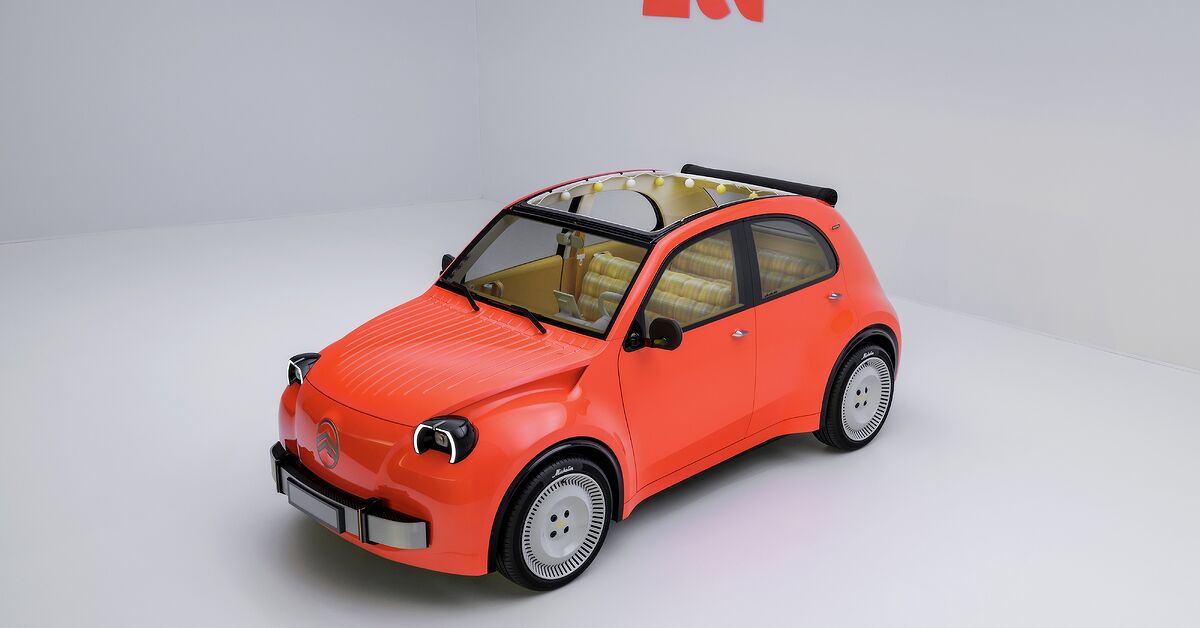
Citroën has pulled one of the most recognizable nameplates out of its history books: the 2CV is coming back, this time as a battery-powered city car. The French brand says a production version could reach European showrooms by 2028, with a projected starting price of roughly €15,000 — about $16,800 at current rates.
The original 2CV arrived in 1948 as basic, cheap transportation for a Europe still rebuilding after the war. It was slow and spartan, but famously easy to fix, and more than five million were built before the last one rolled off the line in 1990. Its air-cooled 375cc flat-twin made just 9 horsepower, and the car was engineered to cross rough ground without tossing its occupants around — or to be repaired at the roadside with a handful of simple tools.
The new interpretation keeps the friendly, rounded silhouette and a few of the old car’s signature tricks, including a retractable cloth roof and a hinged vent panel under the windshield. What changes is the powertrain: the concept is fully electric. Citroën is chasing a curb weight of only about 2,205 pounds, which would be remarkable for any modern EV and nearly unheard of in the segment.
That lightness comes with trade-offs. The 2CV EV is expected to sit below the C3 crossover in both output and range, meaning well under 100 hp and a peak figure short of the C3’s roughly 190 miles. Rumors point to a WLTP rating near 100 miles — likely closer to 80 miles once translated to U.S. testing standards. That would position it as a local runabout rather than a long-distance machine, a concern sharpened by the Citroën Ami, the €8,000 quadricycle that tops out around 28 mph and manages roughly 45 miles in ideal conditions.
Citroën CEO Xavier Chardon framed the project as an attempt to carry forward the original’s spirit rather than simply reproduce it, describing the goal as making electric mobility simpler, more human and more desirable while preserving the accessibility and freedom that defined the 2CV. The concept measures just 148 inches long — smaller than nearly anything on sale today.
The comparison to Volkswagen’s ID. Buzz is unavoidable. VW tried the same nostalgia play with its modern Microbus revival, launched it at $61,500, and discovered that buyers wanted more than 230 miles of range from a family-oriented vehicle at that price. Citroën’s low asking price, if it holds, could help it avoid that fate. Even so, a sub-250-mile EV has historically struggled in North America, and the 2CV’s short range and tiny footprint make a transatlantic launch unlikely.
The debut appears timed to build momentum ahead of the Paris Motor Show, so more concrete details — battery size, final output, and whether the €15,000 figure survives contact with production — should surface soon.
What do you think?