
1963 Buick Riviera Listed at $3,500: Restoration Candidate or Parts Donor?
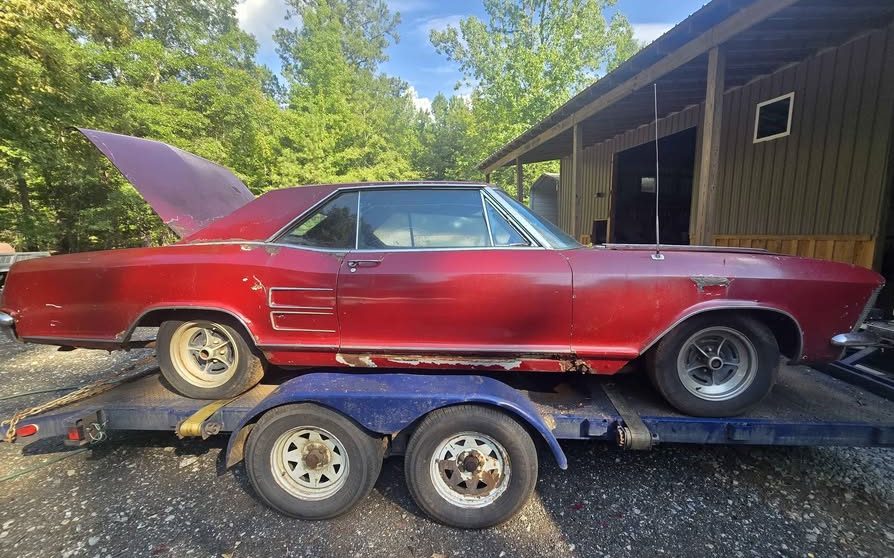
A first-year Buick Riviera has surfaced for sale in Jackson, Georgia, carrying an asking price of just $3,500 through Facebook Marketplace. The listing raises the question every budget-minded enthusiast eventually faces: is this a project worth saving, or a rolling inventory of hard-to-find parts for another Riviera already under restoration?
When Buick launched the Riviera for 1963, it marked the division’s first real push into the personal luxury segment, territory that Ford’s Thunderbird had owned for roughly five years. The clean-sheet styling gave the car a presence that separated it from anything else in GM showrooms at the time, and that reputation is a large part of why early Rivieras still draw attention today.
Mechanically, the car’s strongest asset is its 401-cubic-inch “nailhead” V8, rated at 325 horsepower at 4,400 rpm and 445 lb-ft of torque at 2,800 rpm. Backing it is an automatic transmission and a Posi-traction rear axle. The original build also included power steering, power brakes, and air conditioning, all of which add value if the components are intact and rebuildable.
The body is where the real work lives. The seller openly acknowledges rust issues, and the photos suggest the sheetmetal has deteriorated considerably. Original wheels and chrome are accounted for, but there are no images of the frame or the interior, leaving structural condition and cabin completeness as open questions. The car is finished in red over a gray interior, and the listing notes it has not been driven in years, so whether it currently runs and moves is unclear.
Pricing context matters here. Early Rivieras in genuinely good driving condition tend to change hands around $27,709 on average, according to the listing, and exceptionally clean originals have been seen closer to $45,000. That gap is the crux of the decision: professional restoration work and replacement parts are expensive, and a rust-affected shell can easily consume more than a finished car is worth. Buyers weighing this one against a complete project should factor in a realistic total before committing.
The upside is the low entry price and the presence of desirable factory equipment. The downside is the unknown — no frame photos, no interior photos, and a car that has sat idle for years. For someone already deep into an early Riviera build and hunting specific components, this could be a practical acquisition. For anyone hoping to return it to the road, the math deserves careful scrutiny first.
What do you think?