
- Explain the differences between a prototype BMS and a production-ready BMS.
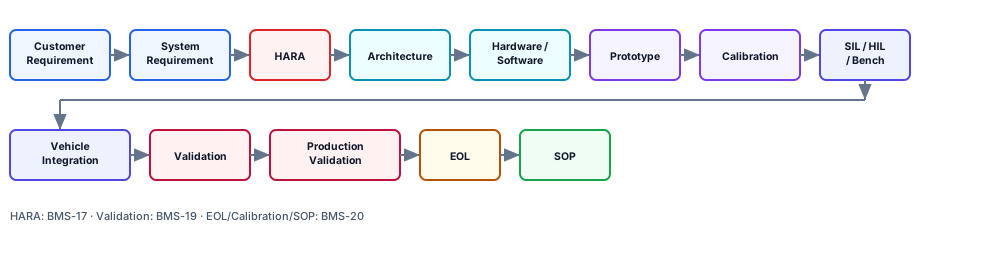
- Sequence the development process from requirements to SOP.
- Define EOL testing, calibration, and production validation.
- Explain why traceability is mandatory for functional safety and quality.
BMS-20 — Production BMS Development
1. “It Works” and “Ready for Production” Aren’t the Same Thing
A prototype can work correctly on a single lab sample under carefully controlled conditions. In production, thousands of units get built on different assembly lines, with different component tolerances, and have to keep working across different climates for years. The gap between “it worked once” and “every unit works reliably under every condition” is exactly what this whole process — calibration, EOL testing, production validation — exists to close.
2. From Requirements to SOP
Customer Requirement → System Requirement → HARA → Architecture → Hardware → Software
→ Prototype → Bring-up → Calibration → SIL → HIL → Battery Bench → Vehicle Integration
→ Validation → Production Validation → EOL → SOP
Each stage uses the previous one’s output as its input: you can’t design an architecture without requirements, you can’t develop hardware/software without an architecture, and an unverified design can’t go into production. The flow looks linear but is iterative in practice; the goal is to keep a bug at one stage from carrying over into the next.
3. Calibration: Tying the Algorithm to the Real Cell
Calibration matches the SOC/SOH algorithms (BMS-08, BMS-09) and protection limits to the real cell’s characteristics. For instance, the OCV-SOC curve (BMS-08) is measured through lab characterization tests for each cell chemistry/supplier and loaded into the BMS software as a table — a bad calibration makes even a correctly working algorithm produce the wrong result.
ASSUMPTION — The process flow described here is a general conceptual model; a real OEM’s steps, naming, and gates can vary according to its own quality system.
4. EOL: 100% Testing, Not Sampling
EOL testing verifies every unit at the end of the production line — measurement accuracy, communication, HVIL, isolation, calibration parameters. Why test every single unit? Because component tolerances (resistors, ADCs, connectors) vary slightly from unit to unit; EOL confirms individually, for every unit, that these variations stay within the design budget (like the measurement-error budget in BMS-03) — it’s not a sampling test.
Production validation confirms the manufacturing process is consistently producing units that meet spec. SOP (Start of Production) is the formal beginning of series production.
5. Traceability: Everything Has to Be Traceable
Traceability is the ability to trace the links between requirement → design → code → test; Automotive SPICE and ISO 26262 make it mandatory. Why? Because without traceability, you can’t reliably answer “was this safety goal actually tested?” Every requirement needs to link to at least one design decision, and every decision to at least one test — critical both for safety audits and for tracing a field failure back to its root cause.
6. Where the Process Can Break
Calibration data being loaded incorrectly or incompletely, EOL testing missing a fault (insufficient coverage), and an unnoticed component change in the supply chain (a different AFE revision, say) — these are typical risks. Change management and regularly reviewing EOL test coverage are part of the process discipline that guards against them.
7. The Process Itself Gets Audited
Automotive SPICE assessments confirm the development process (from requirements management through testing) is being run at a defined level of maturity — this is verifying the reliability of the process that produces a BMS, not any single unit.
8. How It Connects to Other Systems
The production process makes the functional safety concept (BMS-17) verifiable, carries the results of the validation strategy (BMS-19) into production, and ensures every layer of the software architecture (BMS-16) reaches the field calibrated and tested.
Summary
- Production BMS demands quality/safety/regulatory compliance beyond what a prototype needs.
- The process moves from requirements to SOP through staged verification; each stage builds on the last.
- Calibration, EOL, and traceability are non-negotiable in production.
- EOL runs on a 100%-test principle, not sampling; traceability underpins safety audits and root-cause analysis.
Sources
- Automotive SPICE — process reference.
- ISO 26262 — production and validation.
Technical Diagrams
Quiz
What's the purpose of EOL testing?
EOL testing verifies every manufactured unit's spec compliance, following a 100%-test principle.
What does SOP (Start of Production) mean?
SOP is the formal beginning of series production, after all verification and validation steps are complete.
Why is calibration necessary?
Calibration ensures the algorithms are correctly adapted to real cell behavior.
What does traceability provide?
Traceability is needed to prove every requirement was tested and to enable root-cause analysis.
Why does EOL testing need a '100% test principle' rather than sampling?
Since manufacturing tolerances vary by unit, each unit must be individually confirmed to stay within the design budget.
Why is an unnoticed component revision change in the supply chain (e.g., a different AFE revision) risky?
Without change management, a component revision can break previously verified assumptions — which is why change control is necessary.
Glossary
| English Term | Definition |
|---|---|
| EOL (End-of-Line) Test | Verification, at the end of the production line, of every unit's measurement, communication, HVIL, and calibration. |
| Calibration | Matching the SOC/SOH algorithms and protection limits to a real cell's characteristics. |
| Traceability | The ability to trace the links between requirement → design → code → test; mandated by ISO 26262 and Automotive SPICE. |
| Production Validation | The process confirming that the manufacturing process consistently produces units meeting spec. |
| SOP (Start of Production) | The formal start of series production once all verification and validation steps are complete. (Not to be confused with State of Power.) |